


Page 105 - untitled
P. 105
AAAC46  21/5/05  10:53 AM  Page 104
                                                                                      Gluteus medius
                      Gluteus medius
                                                                                      Gluteus minimus
                      Gluteus maximus
                                                                                      Superior gluteal artery and nerve
                                                                                      Inferior gluteal nerve
                                                                                      Piriformis
                                                                                      Obturator internus and gemelli
                      Femoral insertion                                               Inferior gluteal artery
                      of gluteus maximus                                              Quadratus femoris
                                                                                      Posterior cutaneous nerve of thigh
                      Internal pudendal nerve
                      and artery                                                      Sciatic nerve
                      Vastus lateralis
                      Biceps femoris                                                  Adductor magnus
                      Semimembranosus
                                                                                      Opening in adductor magnus
                      Semitendinosus
                                                                                      Biceps (short head)
                                                                                      Biceps (long head)

                                                                                      Sciatic nerve
                                                                                      Semimembranosus tendon


                      Gastrocnemius


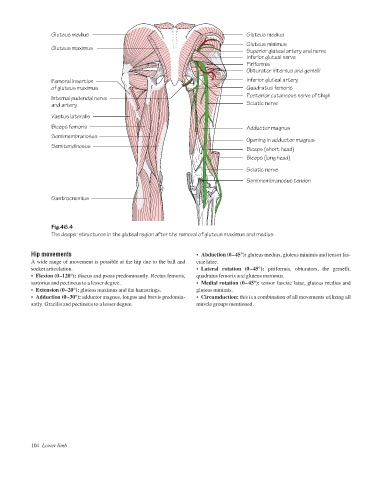
                      Fig.46.4
                      The deeper structures in the gluteal region after the removal of gluteus maximus and medius


                Hip movements                                         • Abduction (0–45°): gluteus medius, gluteus minimis and tensor fas-
                A wide range of movement is possible at the hip due to the ball and  ciae latae.
                socket articulation.                                  • Lateral rotation (0–45°): piriformis, obturators, the gemelli,
                • Flexion (0–120°): iliacus and psoas predominantly. Rectus femoris,  quadratus femoris and gluteus maximus.
                sartorius and pectineus to a lesser degree.           • Medial rotation (0–45°): tensor fasciae latae, gluteus medius and
                • Extension (0–20°): gluteus maximus and the hamstrings.  gluteus minimis.
                • Adduction (0–30°): adductor magnus, longus and brevis predomin-  • Circumduction: this is a combination of all movements utilizing all
                antly. Gracilis and pectineus to a lesser degree.     muscle groups mentioned.


                104 Lower limb

