


Page 106 - untitled
P. 106
AAAC46  21/5/05  10:53 AM  Page 105
                                          Iliolumbar
                                                                                       Arteries from capsule in retinacula
                                          ligament
                                                         Body weight
                                                                                                 Artery in
                                                                                                 ligamentum teres
                Long and short
                posterior ligaments
                Greater sciatic
                foramen
                Sacrospinous
                ligament                                         Sacrotuberous
                Sacrotuberous                                    ligament
                ligament
                                                                                             Subcapital
                Fig.46.5                       Ischiofemoral ligament                        Cervical     Intracapsular
                                                                                             Basal
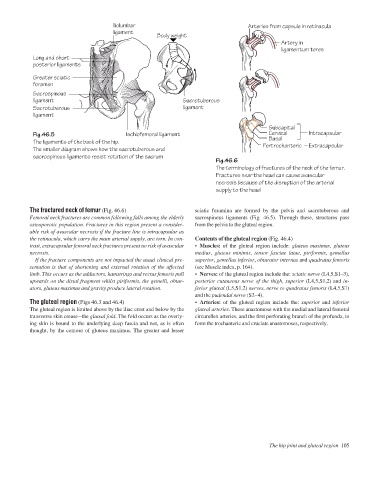
                The ligaments of the back of the hip.
                                                                                           Pertrochanteric  Extracapsular
                The smaller diagram shows how the sacrotuberous and
                sacrospinous ligaments resist rotation of the sacrum
                                                                            Fig.46.6
                                                                            The terminology of fractures of the neck of the femur.
                                                                            Fractures near the head can cause avascular
                                                                            necrosis because of the disruption of the arterial
                                                                            supply to the head


               The fractured neck of femur (Fig. 46.6)               sciatic foramina are formed by the pelvis and sacrotuberous and
               Femoral neck fractures are common following falls among the elderly  sacrospinous ligaments (Fig. 46.5). Through these, structures pass
               osteoporotic population. Fractures in this region present a consider-  from the pelvis to the gluteal region.
               able risk of avascular necrosis if the fracture line is intracapsular as
               the retinacula, which carry the main arterial supply, are torn. In con-  Contents of the gluteal region (Fig. 46.4)
               trast, extracapsular femoral neck fractures present no risk of avascular  • Muscles: of the gluteal region include:  gluteus maximus,  gluteus
               necrosis.                                             medius,  gluteus minimis,  tensor fasciae latae,  piriformis,  gemellus
                 If the fracture components are not impacted the usual clinical pre-  superior, gemellus inferior, obturator internus and quadratus femoris
               sentation is that of shortening and external rotation of the affected  (see Muscle index, p. 164).
               limb. This occurs as the adductors, hamstrings and rectus femoris pull  • Nerves: of the gluteal region include the: sciatic nerve (L4,5,S1–3),
               upwards on the distal fragment whilst piriformis, the gemelli, obtur-  posterior cutaneous nerve of the thigh, superior (L4,5,S1,2) and in-
               ators, gluteus maximus and gravity produce lateral rotation.  ferior gluteal (L5,S1,2) nerves, nerve to quadratus femoris (L4,5,S1)
                                                                     and the pudendal nerve (S2–4).
               The gluteal region (Figs 46.3 and 46.4)               • Arteries: of the gluteal region include the:  superior  and inferior
               The gluteal region is limited above by the iliac crest and below by the  gluteal arteries. These anastomose with the medial and lateral femoral
               transverse skin creaseathe gluteal fold. The fold occurs as the overly-  circumflex arteries, and the first perforating branch of the profunda, to
               ing skin is bound to the underlying deep fascia and not, as is often  form the trochanteric and cruciate anastomoses, respectively.
               thought, by the contour of gluteus maximus. The greater and lesser


                                                                                              The hip joint and gluteal region 105

