


Page 179 - Concise Pathology for Exam Preparation ( PDFDrive )
P. 179
164   SECTION I  General Pathology


                        c)  Hospital-acquired  pneumonia:  Defined  as  pulmonary  infections  acquired  during
                          course of hospital stay. Causative organisms include
                            (i)  Gram-negative rods
                           (ii)  Enterobacteriaceae
                          (iii)  Pseudomonas, Staphylococcus aureus (methicillin resistant)
                       d)  Aspiration (inhalation) pneumonia: Usually seen in debilitated, comatose or uncon-
                          scious patients. Aspiration of gastric contents results in chemical irritation (due to
                          gastric acid) and also bacterial infection. It is typically associated with anaerobic
                          infection (oral flora) mixed with aerobic organisms.
                        e)  Chronic pneumonia: It is a localized lesion with or without lymph node involvement,
                          typically showing granulomatous inflammation. Causative organisms include Nocar-
                          dia, Actinomyces, M. tuberculosis, atypical mycobacteria, histoplasmosis, Coccidioides
                          immitis and Blastomyces dermatitidis.
                        f)  Necrotizing pneumonia and lung abscess: It is caused by anaerobic oral flora mixed
                          with or without aerobic organisms, eg, Staphylococcus aureus, Klebsiella pneumoniae,
                          Streptococcus pyogenes, Pneumococcus (type III).
                       g)  Pneumonia in an immunocompromised host: Caused by opportunistic agents which
                          rarely infect normal hosts, namely, Cytomegalovirus, Pneumocystis jiroveci, Mycobac-
                          terium avium-intracellulare, invasive aspergillosis and invasive candidiasis. This pres-
                          ents with pulmonary infiltrates with or without other signs.
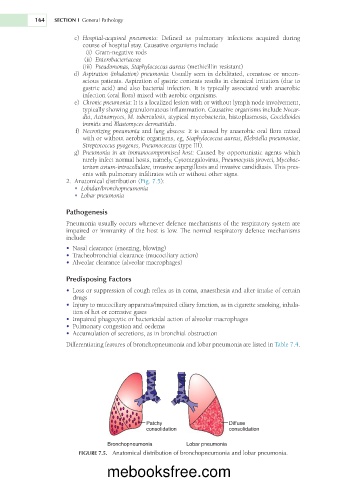
                       2.  Anatomical distribution (Fig. 7.5):
                        •  Lobular/bronchopneumonia
                        •  Lobar pneumonia

                     Pathogenesis
                     Pneumonia usually occurs whenever defence mechanisms of the respiratory system are
                     impaired or immunity of the host is low. The normal respiratory defence mechanisms
                     include
                     •  Nasal clearance (sneezing, blowing)
                     •  Tracheobronchial clearance (mucociliary action)
                     •  Alveolar clearance (alveolar macrophages)

                     Predisposing Factors
                     •  Loss or suppression of cough reflex as in coma, anaesthesia and after intake of certain
                       drugs
                     •  Injury to mucociliary apparatus/impaired ciliary function, as in cigarette smoking, inhala-
                       tion of hot or corrosive gases
                     •  Impaired phagocytic or bactericidal action of alveolar macrophages
                     •  Pulmonary congestion and oedema
                     •  Accumulation of secretions, as in bronchial obstruction

                     Differentiating features of bronchopneumonia and lobar pneumonia are listed in Table 7.4.


                                              Patchy                    Diffuse
                                              consolidation             consolidation

                                  Bronchopneumonia        Lobar pneumonia
                         FIGURE 7.5.  Anatomical distribution of bronchopneumonia and lobar pneumonia.


                                  mebooksfree.com

