


Page 180 - Concise Pathology for Exam Preparation ( PDFDrive )
P. 180
7  Infections  165


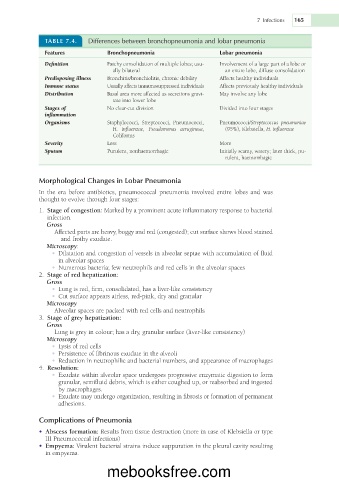
               TABLE 7.4.   Differences between bronchopneumonia and lobar pneumonia

               Features           Bronchopneumonia                   Lobar pneumonia
               Definition         Patchy consolidation of multiple lobes; usu-  Involvement of a large part of a lobe or
                                    ally bilateral                    an entire lobe, diffuse consolidation
               Predisposing illness  Bronchitis/bronchiolitis, chronic debility  Affects healthy individuals
               Immune status      Usually affects immunosuppressed individuals   Affects previously healthy individuals
               Distribution       Basal area more affected as secretions gravi-  May involve any lobe
                                    tate into lower lobe
               Stages of          No clear-cut division              Divided into four stages
               inflammation
               Organisms          Staphylococci,  Streptococci,  Pneumococci,     Pneumococci/Streptococcus  pneumoniae
                                    H.  influenzae,  Pseudomonas  aeruginosa,   (95%), Klebsiella, H. influenzae
                                    Coliforms
               Severity           Less                               More
               Sputum             Purulent, nonhaemorrhagic          Initially scanty, watery; later thick, pu-
                                                                      rulent, haemorrhagic


             Morphological Changes in Lobar Pneumonia
             In  the  era  before  antibiotics,  pneumococcal  pneumonia  involved  entire  lobes  and  was
             thought to evolve through four stages:
               1.  Stage of congestion: Marked by a prominent acute inflammatory response to bacterial
                infection.
               Gross
                  Affected parts are heavy, boggy and red (congested); cut surface shows blood stained
                    and frothy exudate.
               Microscopy:
                 •  Dilatation and congestion of vessels in alveolar septae with accumulation of fluid
                   in alveolar spaces
                 •  Numerous bacteria; few neutrophils and red cells in the alveolar spaces
               2.  Stage of red hepatization:
               Gross
                 •  Lung is red, firm, consolidated, has a liver-like consistency
                 •  Cut surface appears airless, red-pink, dry and granular
               Microscopy
                  Alveolar spaces are packed with red cells and neutrophils
               3.  Stage of grey hepatization:
               Gross
                  Lung is grey in colour; has a dry, granular surface (liver-like consistency)
               Microscopy
                 •  Lysis of red cells
                 •  Persistence of fibrinous exudate in the alveoli
                 •  Reduction in neutrophilic and bacterial numbers, and appearance of macrophages
               4.  Resolution:
                 •  Exudate within alveolar space undergoes progressive enzymatic digestion to form
                   granular, semifluid debris, which is either coughed up, or reabsorbed and ingested
                   by macrophages.
                 •  Exudate may undergo organization, resulting in fibrosis or formation of permanent
                   adhesions.

             Complications of Pneumonia
             •  Abscess formation: Results from tissue destruction (more in case of Klebsiella or type
               III Pneumococcal infections)
             •  Empyema: Virulent bacterial strains induce suppuration in the pleural cavity resulting
               in empyema.


                                  mebooksfree.com

