


Page 187 - Concise Pathology for Exam Preparation ( PDFDrive )
P. 187
172   SECTION I  General Pathology

                     Parvovirus B19

                     Produces erythema infectiosum (fifth disease), which typically manifests with a confluent
                     maculopapular rash, usually beginning on the cheeks (giving a ‘slapped-face’ appearance)
                     and extending centripetally to involve trunk.

                     Viral Haemorrhagic Fevers
                     •  These are systemic infections characterized by fever and haemorrhages. They are caused
                       by enveloped RNA viruses belonging to four different families: arena virus, filo virus,
                       bunya virus and flavivirus.
                     •  The  viruses  survive  in  animals  and  are  transmitted  by  insects.  Humans  are  infected
                       when they come in contact with infected hosts and vectors.
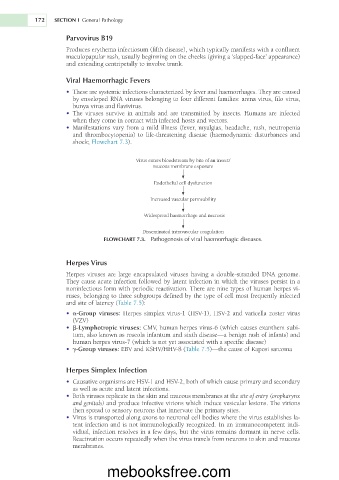
                     •  Manifestations vary from a mild illness (fever, myalgias, headache, rash, neutropenia
                       and  thrombocytopenia)  to  life-threatening  disease  (haemodynamic  disturbances  and
                       shock; Flowchart 7.3).

                                           Virus enters bloodstream by bite of an insect/
                                                mucous membrane exposure


                                                Endothelial cell dysfunction

                                               Increased vascular permeability

                                             Widespread haemorrhage and necrosis

                                             Disseminated intravascular coagulation
                                 FLOWCHART 7.3.  Pathogenesis of viral haemorrhagic diseases.


                     Herpes Virus
                     Herpes  viruses  are  large  encapsulated  viruses  having  a  double-stranded  DNA  genome.
                     They cause acute infection followed by latent infection in which the viruses persist in a
                     noninfectious form with periodic reactivation. There are nine types of human herpes vi-
                     ruses, belonging to three subgroups defined by the type of cell most frequently infected
                     and site of latency (Table 7.5):
                     •  a-Group  viruses: Herpes simplex virus-1 (HSV-1), HSV-2 and varicella zoster virus
                       (VZV)
                     •  b-Lymphotropic viruses: CMV, human herpes virus-6 (which causes exanthem subi-
                       tum, also known as roseola infantum and sixth disease—a benign rash of infants) and
                       human herpes virus-7 (which is not yet associated with a specific disease)
                     •  g-Group viruses: EBV and KSHV/HHV-8 (Table 7.5)—the cause of Kaposi sarcoma


                     Herpes Simplex Infection

                     •  Causative organisms are HSV-1 and HSV-2, both of which cause primary and secondary
                       as well as acute and latent infections.
                     •  Both viruses replicate in the skin and mucous membranes at the site of entry (oropharynx
                       and genitals) and produce infective virions which induce vesicular lesions. The virions
                       then spread to sensory neurons that innervate the primary sites.
                     •  Virus is transported along axons to neuronal cell bodies where the virus establishes la-
                       tent infection and is not immunologically recognized. In an immunocompetent indi-
                       vidual, infection resolves in a few days, but the virus remains dormant in nerve cells.
                       Reactivation occurs repeatedly when the virus travels from neurons to skin and mucous
                       membranes.


                                  mebooksfree.com

