


Page 189 - Concise Pathology for Exam Preparation ( PDFDrive )
P. 189
174   SECTION I  General Pathology


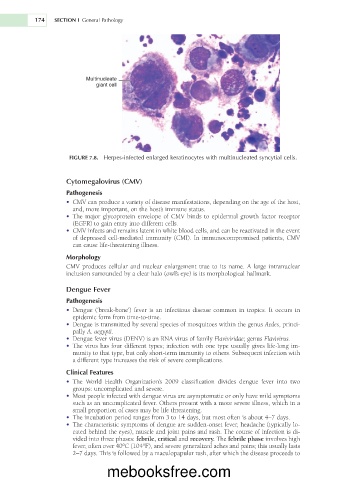
                            Multinucleate
                               giant cell


                      FIGURE 7.8.  Herpes-infected enlarged keratinocytes with multinucleated syncytial cells.


                     Cytomegalovirus (CMV)
                     Pathogenesis
                     •  CMV can produce a variety of disease manifestations, depending on the age of the host,
                       and, more important, on the host’s immune status.
                     •  The major glycoprotein envelope of CMV binds to epidermal growth factor receptor
                       (EGFR) to gain entry into different cells.
                     •  CMV infects and remains latent in white blood cells, and can be reactivated in the event
                       of depressed cell-mediated immunity (CMI). In immunocompromised patients, CMV
                       can cause life-threatening illness.

                     Morphology
                     CMV produces cellular and nuclear enlargement true to its name. A large intranuclear
                     inclusion surrounded by a clear halo (owl’s eye) is its morphological hallmark.

                     Dengue Fever
                     Pathogenesis
                     •  Dengue (‘break-bone’) fever is an infectious disease common in tropics. It occurs in
                       epidemic form from time-to-time.
                     •  Dengue is transmitted by several species of mosquitoes within the genus Aedes, princi-
                       pally A. aegypti.
                     •  Dengue fever virus (DENV) is an RNA virus of family Flaviviridae; genus Flavivirus.
                     •  The virus has four different types; infection with one type usually gives life-long im-
                       munity to that type, but only short-term immunity to others. Subsequent infection with
                       a different type increases the risk of severe complications.

                     Clinical Features
                     •  The  World  Health  Organization’s  2009  classification  divides  dengue  fever  into  two
                       groups: uncomplicated and severe.
                     •  Most people infected with dengue virus are asymptomatic or only have mild symptoms
                       such as an uncomplicated fever. Others present with a more severe illness, which in a
                       small proportion of cases may be life threatening.
                     •  The incubation period ranges from 3 to 14 days, but most often is about 4–7 days.
                     •  The characteristic symptoms of dengue are sudden-onset fever, headache (typically lo-
                       cated behind the eyes), muscle and joint pains and rash. The course of infection is di-
                       vided into three phases: febrile, critical and recovery. The febrile phase involves high
                       fever, often over 40°C (104°F), and severe generalized aches and pains; this usually lasts
                       2–7 days. This is followed by a maculopapular rash, after which the disease proceeds to


                                  mebooksfree.com

