


Page 192 - Concise Pathology for Exam Preparation ( PDFDrive )
P. 192
7  Infections  177


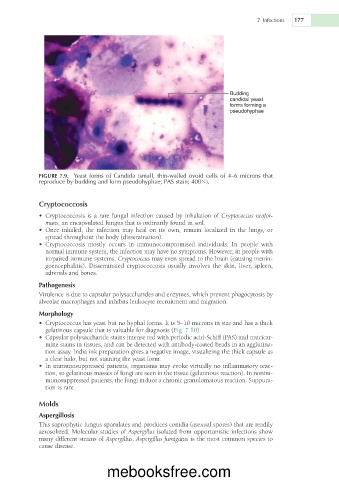
                                                                        Budding
                                                                        candidal yeast
                                                                        forms forming a
                                                                        pseudohyphae


             FIGURE  7.9.  Yeast  forms  of  Candida  (small,  thin-walled  ovoid  cells  of  4–6  microns  that
             reproduce by budding and form pseudohyphae; PAS stain; 4003).


             Cryptococcosis

             •  Cryptococcosis is a rare fungal infection caused by inhalation of Cryptococcus neofor-
               mans, an encapsulated fungus that is ordinarily found in soil.
             •  Once  inhaled,  the  infection  may  heal  on  its  own,  remain  localized  in  the  lungs,  or
               spread throughout the body (dissemination).
             •  Cryptococcosis  mostly  occurs  in  immunocompromised  individuals.  In  people  with
               normal immune system, the infection may have no symptoms. However, in people with
               impaired immune systems, Cryptococcus may even spread to the brain (causing menin-
               goencephalitis).  Disseminated  cryptococcosis  usually  involves  the  skin,  liver,  spleen,
               adrenals and bones.
             Pathogenesis
             Virulence is due to capsular polysaccharides and enzymes, which prevent phagocytosis by
             alveolar macrophages and inhibits leukocyte recruitment and migration.

             Morphology
             •  Cryptococcus has yeast but no hyphal forms. It is 5–10 microns in size and has a thick
               gelatinous capsule that is valuable for diagnosis (Fig. 7.10).
             •  Capsular polysaccharide stains intense red with periodic acid-Schiff (PAS) and mucicar-
               mine stains in tissues, and can be detected with antibody-coated beads in an agglutina-
               tion assay. India ink preparation gives a negative image, visualizing the thick capsule as
               a clear halo, but not staining the yeast form.
             •  In immunosuppressed patients, organisms may evoke virtually no inflammatory reac-
               tion, so gelatinous masses of fungi are seen in the tissue (gelatinous reaction). In nonim-
               munosuppressed patients, the fungi induce a chronic granulomatous reaction. Suppura-
               tion is rare.

             Molds
             Aspergillosis
             This saprophytic fungus sporulates and produces conidia (asexual spores) that are readily
             aerosolized. Molecular studies of Aspergillus isolated from opportunistic infections show
             many different strains of Aspergillus, Aspergillus fumigatus is the most common species to
             cause disease.


                                  mebooksfree.com

