


Page 193 - Concise Pathology for Exam Preparation ( PDFDrive )
P. 193
178   SECTION I  General Pathology


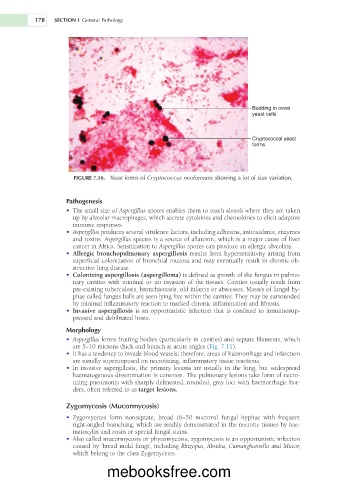
                                                                               Budding in ovoid
                                                                               yeast cells


                                                                               Cryptococcal yeast
                                                                               forms


                        FIGURE 7.10.  Yeast forms of Cryptococcus neoformans showing a lot of size variation.


                     Pathogenesis
                     •  The small size of Aspergillus spores enables them to reach alveoli where they are taken
                       up by alveolar macrophages, which secrete cytokines and chemokines to elicit adaptive
                       immune responses.
                     •  Aspergillus produces several virulence factors, including adhesins, antioxidants, enzymes
                       and toxins. Aspergillus species is a source of aflatoxin, which is a major cause of liver
                       cancer in Africa. Sensitization to Aspergillus spores can produce an allergic alveolitis.
                     •  Allergic bronchopulmonary aspergillosis results from hypersensitivity arising from
                       superficial colonization of bronchial mucosa and may eventually result in chronic ob-
                       structive lung disease.
                     •  Colonizing aspergillosis (aspergilloma) is defined as growth of the fungus in pulmo-
                       nary cavities with minimal or no invasion of the tissues. Cavities usually result from
                       pre-existing tuberculosis, bronchiectasis, old infarcts or abscesses. Masses of fungal hy-
                       phae called fungus balls are seen lying free within the cavities. They may be surrounded
                       by minimal inflammatory reaction to marked chronic inflammation and fibrosis.
                     •  Invasive aspergillosis is an opportunistic infection that is confined to immunosup-
                       pressed and debilitated hosts.

                     Morphology
                     •  Aspergillus forms fruiting bodies (particularly in cavities) and septate filaments, which
                       are 5–10 microns thick and branch at acute angles (Fig. 7.11).
                     •  It has a tendency to invade blood vessels; therefore, areas of haemorrhage and infarction
                       are usually superimposed on necrotizing, inflammatory tissue reactions.
                     •  In invasive aspergillosis, the primary lesions are usually in the lung, but widespread
                       haematogenous dissemination is common. The pulmonary lesions take form of necro-
                       tizing pneumonia with sharply delineated, rounded, grey foci with haemorrhagic bor-
                       ders, often referred to as target lesions.

                     Zygomycosis (Mucormycosis)

                     •  Zygomycetes  form  nonseptate,  broad  (6–50  microns)  fungal  hyphae  with  frequent
                       right-angled branching, which are readily demonstrated in the necrotic tissues by hae-
                       matoxylin and eosin or special fungal stains.
                     •  Also called mucormycosis or phycomycosis, zygomycosis is an opportunistic infection
                       caused by ‘bread mold fungi’, including Rhizopus, Absidia, Cumunghanrella and Mucor,
                       which belong to the class Zygomycetes.


                                  mebooksfree.com

