


Page 194 - Concise Pathology for Exam Preparation ( PDFDrive )
P. 194
7  Infections  179


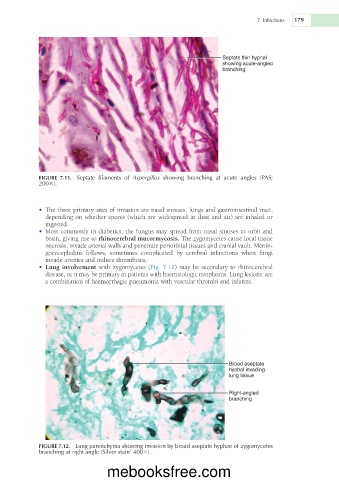
                                                                      Septate thin hyphal
                                                                      showing acute-angled
                                                                      branching


             FIGURE  7.11.  Septate  filaments  of  Aspergillus  showing  branching  at  acute  angles  (PAS;
             2003).


             •  The three primary sites of invasion are nasal sinuses, lungs and gastrointestinal tract,
               depending on whether spores (which are widespread in dust and air) are inhaled or
               ingested.
             •  Most commonly in diabetics, the fungus may spread from nasal sinuses to orbit and
               brain, giving rise to rhinocerebral mucormycosis. The zygomycetes cause local tissue
               necrosis, invade arterial walls and penetrate periorbital tissues and cranial vault. Menin-
               goencephalitis  follows,  sometimes  complicated  by  cerebral  infarctions  when  fungi
               invade arteries and induce thrombosis.
             •  Lung involvement with zygomycetes (Fig. 7.12) may be secondary to rhinocerebral
               disease, or it may be primary in patients with haematologic neoplasms. Lung lesions  are
               a combination of haemorrhagic pneumonia with vascular thrombi and infarcts.


                                                                        Broad aseptate
                                                                        hyphal invading
                                                                        lung tissue

                                                                        Right-angled
                                                                        branching


             FIGURE 7.12.  Lung parenchyma showing invasion by broad aseptate hyphae of zygomycetes
             branching at right angle (Silver stain’ 4003).


                                  mebooksfree.com

