


Page 195 - Concise Pathology for Exam Preparation ( PDFDrive )
P. 195
180   SECTION I  General Pathology

                     Mycetoma
                     Mycetoma can be classified as a Eumycetoma—a fungal disease, or Actinomycetoma—an
                     old name for Actinomycosis.
                     Eumycetoma
                     •  It is a chronic, specific, granulomatous, fungal disease which mainly affects the foot.
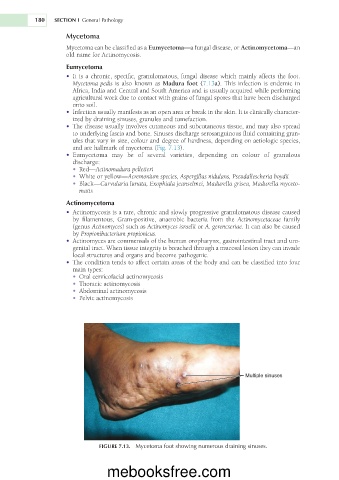
                       Mycetoma pedis is also known as Madura foot (7.13a). This infection is endemic in
                       Africa, India and Central and South America and is usually acquired while performing
                       agricultural work due to contact with grains of fungal spores that have been discharged
                       onto soil.
                     •  Infection usually manifests as an open area or break in the skin. It is clinically character-
                       ized by draining sinuses, granules and tumefaction.
                     •  The disease usually involves cutaneous and subcutaneous tissue, and may also spread
                       to underlying fascia and bone. Sinuses discharge serosanguinous fluid containing gran-
                       ules that vary in size, colour and degree of hardness, depending on aetiologic species,
                       and are hallmark of mycetoma (Fig. 7.13).
                     •  Eumycetoma  may  be  of  several  varieties,  depending  on  colour  of  granulous
                       discharge:
                       •  Red—Actinomadura pelletieri
                       •  White or yellow—Acremonium species, Aspergillus nidulans, Pseudallescheria boydii
                       •  Black—Curvularia lunata, Exophiala jeanselmei, Madurella grisea, Madurella myceto-
                         matis
                     Actinomycetoma
                     •  Actinomycosis is a rare, chronic and slowly progressive granulomatous disease caused
                       by  filamentous,  Gram-positive,  anaerobic  bacteria  from  the  Actinomycetaceae  family
                       (genus Actinomyces) such as Actinomyces israelii or A. gerencseriae. It can also be caused
                       by Propionibacterium propionicus.
                     •  Actinomyces are commensals of the human oropharynx, gastrointestinal tract and uro-
                       genital tract. When tissue integrity is breached through a mucosal lesion they can invade
                       local structures and organs and become pathogenic.
                     •  The condition tends to affect certain areas of the body and can be classified into four
                       main types:
                       •  Oral cervicofacial actinomycosis
                       •  Thoracic actinomycosis
                       •  Abdominal actinomycosis
                       •  Pelvic actinomycosis


                                                                             Multiple sinuses


                                FIGURE 7.13.  Mycetoma foot showing numerous draining sinuses.


                                  mebooksfree.com

