


Page 196 - Concise Pathology for Exam Preparation ( PDFDrive )
P. 196
7  Infections  181


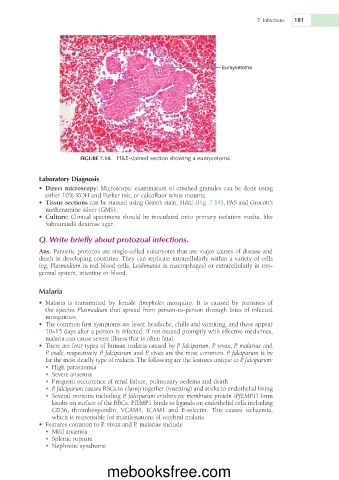
                                                                     Eumycetoma


                          FIGURE 7.14.  H&E-stained section showing a eumycetoma.


             Laboratory Diagnosis
             •  Direct microscopy: Microscopic examination of crushed granules can be done using
               either 10% KOH and Parker ink, or calcofluor white mounts.
             •  Tissue sections can be stained using Gram’s stain, H&E (Fig. 7.14), PAS and Grocott’s
               methenamine silver (GMS).
             •  Culture: Clinical specimens should be inoculated onto primary isolation media, like
               Sabouraud’s dextrose agar.

             Q. Write briefly about protozoal infections.

             Ans. Parasitic protozoa are single-celled eukaryotes that are major causes of disease and
             death in developing countries. They can replicate intracellularly within a variety of cells
             (eg, Plasmodium in red blood cells, Leishmania in macrophages) or extracellularly in uro-
             genital system, intestine or blood.

             Malaria

             •  Malaria  is  transmitted  by  female  Anopheles  mosquito.  It  is  caused  by  parasites  of
               the species Plasmodium that spread from person-to-person through bites of infected
               mosquitoes.
             •  The common first symptoms are fever, headache, chills and vomiting, and these appear
               10–15 days after a person is infected. If not treated promptly with effective medicines,
               malaria can cause severe illness that is often fatal.
             •  There are four types of human malaria caused by P. falciparum, P. vivax, P. malariae and
               P. ovale, respectively. P. falciparum and P. vivax are the most common. P. falciparum is by
               far the most deadly type of malaria. The following are the features unique to P. falciparum:
               •  High parasitemia
               •  Severe anaemia
               •  Frequent occurrence of renal failure, pulmonary oedema and death
               •  P. falciparum causes RBCs to clump together (rosetting) and sticks to endothelial lining
               •  Several proteins including P. falciparum erythrocyte membrane protein (PfEMP1) form
                 knobs on surface of the RBCs. PfEMP1 binds to ligands on endothelial cells including
                 CD36,  thrombospondin,  VCAM1,  ICAM1  and  E-selectin.  This  causes  ischaemia,
                 which is responsible for manifestations of cerebral malaria.
             •  Features common to P. vivax and P. malariae include
               •  Mild anaemia
               •  Splenic rupture
               •  Nephrotic syndrome


                                  mebooksfree.com

