


Page 197 - Concise Pathology for Exam Preparation ( PDFDrive )
P. 197
182   SECTION I  General Pathology

                     Life Cycle (Flowchart 7.4)

                                           Sporozoites reach blood by bite of an infected
                                                mosquito (female Anopheles)


                                      They invade and attach to liver cells (binding to hepatocytic
                                        receptors for proteins thrombospondin and properdin)

                                              Multiply asexually in the liver cells  Hepatic phase

                                            Merozoites (asexual haploid forms) released
                                            into circulation when hepatocytes rupture


                                         Bind to RBCs via lectin on glycophorin molecules
                                          of RBC membrane (P. vivax binds to Duffy Ag)

                                          Merozoites  release  proteases  from  a  special
                                                 organelle called Rhoptry   Erythrocytic phase

                                         Multiply in RBCs, within which parasites grow in
                                         membrane-bound digestive vacuoles and hydrolyse
                                    haemoglobin via serotonin enzymes, converting haem to haemozoin

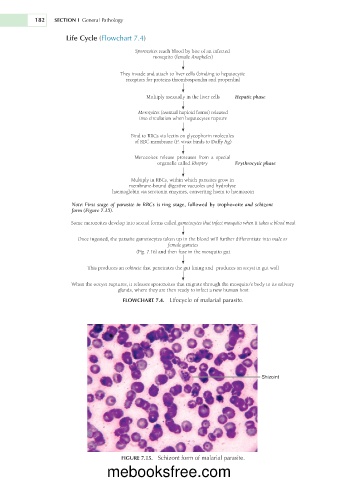
                       Note: First stage of parasite  in  RBCs  is ring stage, followed  by  trophozoite and  schizont
                       form (Figure 7.15).
                       Some merozoites develop into sexual forms called gametocytes that infect mosquito when it takes a blood meal

                         Once ingested, the parasite gametocytes taken up in the blood will further differentiate into male or
                                                     female gametes
                                           (Fig. 7.16) and then fuse in the mosquito gut

                            This produces an ookinete that penetrates the gut lining and  produces an oocyst in gut wall

                       When the oocyst ruptures, it releases sporozoites that migrate through the mosquito’s body to its salivary
                                     glands, where they are then ready to infect a new human host
                                       FLOWCHART 7.4.  Lifecycle of malarial parasite.


                                                                                  Shizoint


                                      FIGURE 7.15.  Schizont form of malarial parasite.

                                  mebooksfree.com

