


Page 198 - Concise Pathology for Exam Preparation ( PDFDrive )
P. 198
7  Infections  183


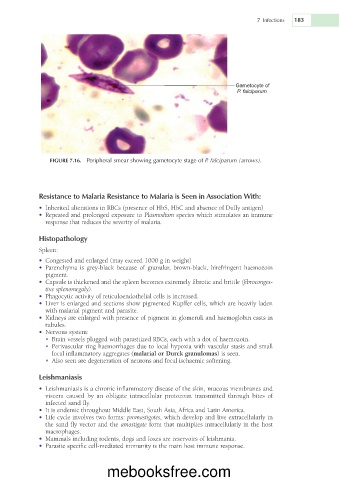
                                                                          Gametocyte of
                                                                          P. falciparum


                FIGURE 7.16.  Peripheral smear showing gametocyte stage of P. falciparum (arrows).


             Resistance to Malaria Resistance to Malaria is Seen in Association With:
             •  Inherited alterations in RBCs (presence of HbS, HbC and absence of Duffy antigen)
             •  Repeated and prolonged exposure to Plasmodium species which stimulates an immune
               response that reduces the severity of malaria.

             Histopathology
             Spleen:
             •  Congested and enlarged (may exceed 1000 g in weight)
             •  Parenchyma  is  grey-black  because  of  granular,  brown-black,  birefringent  haemozoin
               pigment.
             •  Capsule is thickened and the spleen becomes extremely fibrotic and brittle (fibroconges-
               tive splenomegaly).
             •  Phagocytic activity of reticuloendothelial cells is increased.
             •  Liver is enlarged and sections show pigmented Kupffer cells, which are heavily laden
               with malarial pigment and parasite.
             •  Kidneys are enlarged with presence of pigment in glomeruli and haemoglobin casts in
               tubules.
             •  Nervous system:
               •  Brain vessels plugged with parasitized RBCs, each with a dot of haemozoin.
               •  Perivascular ring haemorrhages due to local hypoxia with vascular stasis and small
                 focal inflammatory aggregates (malarial or Durck granulomas) is seen.
               •  Also seen are degeneration of neurons and focal ischaemic softening.

             Leishmaniasis
             •  Leishmaniasis is a chronic inflammatory disease of the skin, mucous membranes and
               viscera  caused  by  an  obligate  intracellular  protozoan  transmitted  through  bites  of
               infected sand fly.
             •  It is endemic throughout Middle East, South Asia, Africa and Latin America.
             •  Life cycle involves two forms: promastigotes, which develop and live extracellularly in
               the sand fly vector and the amastigote form that multiplies intracellularly in the host
               macrophages.
             •  Mammals including rodents, dogs and foxes are reservoirs of leishmania.
             •  Parasite specific cell-mediated immunity is the main host immune response.


                                  mebooksfree.com

