


Page 632 - Concise Pathology for Exam Preparation ( PDFDrive )
P. 632
23    The Central Nervous System   617


                     Late  	sequelae:


                     -	 Exudate and fibrous adhesions leading to obstructive hydrocephalus
�

                       - Tuberculous encephalitis
�
                       - Tuberculosis of the spine
�

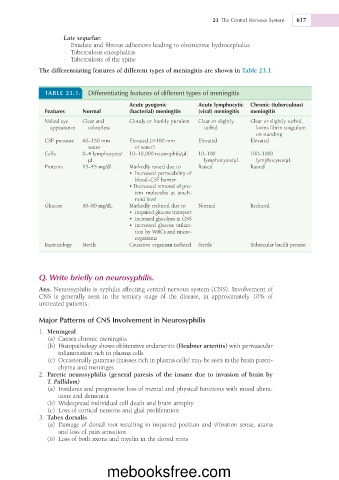
             The  	differentiating  	features  	 	different  	types  	 	meningitis  	are  	shown  	 	Table  	23.1.
                                                                         in
                                                    of
                                     of
               TABLE   23.1.  Differentiating features of different types of meningitis
                                         Acute pyogenic       Acute lymphocytic  Chronic (tuberculous)
               Features   Normal         (bacterial) meningitis   (viral) meningitis   meningitis
               Naked eye     Clear and     Cloudy or frankly purulent   Clear or slightly     Clear or slightly turbid,
                 appearance   colourless                        turbid          forms fibrin coagulum
                                                                                on standing
               CSF pressure   60–150 mm     Elevated (.180 mm   Elevated      Elevated
                            water          of water)
               Cells      0–4 lymphocytes/   10–10,000 neutrophils/µL   10–100     100–1000
                            µL                                  lymphocytes/µL   lymphocytes/µL
               Proteins   15–45 mg/dL    Markedly raised due to   Raised      Raised
                                            •  Increased permeability of
                                           blood–CSF barrier
                                         • Decreased removal of pro-
                                           tein  molecules  at  arach-
                                           noid level
               Glucose    50–80 mg/dL    Markedly reduced due to   Normal     Reduced

                                            •  Impaired glucose transport

                                            •  Increased glycolysis in CNS


                                            •  Increased glucose utiliza-
                                           tion by WBCs and micro-
                                           organisms
               Bacteriology   Sterile    Causative organism isolated   Sterile   Tubercular bacilli present

             Q.   Write briefly on neurosyphilis.

             Ans.   Neurosyphilis     syphilis   affecting   central   nervous   system   (CNS).   Involvement   of
                              s
                              i


                                                  o

             CNS      generally  seen  in  the  tertiary  stage      the  disease,  in  approximately  10%     f


                                                                                   o
                                                   f
                  s
                  i

             untreated   patients.
             Major Patterns of CNS Involvement in Neurosyphilis
             1.
                 Meningeal
                    Causes chronic meningitis
                (a)


                (    )  Histopathology shows obliterative endarteritis (Heubner  	arteritis)  with perivascular

                b
                   inflammation   rich in plasma cells


                    Occasionally gummas (masses rich in plasma cells) may be seen in the brain paren-
                (c)
                   chyma and meninges
                                                                           of
                                                                 to
                                                 of
                 Paretic
             2.      	neurosyphilis  	(general  	paresis  	 	the  	insane  	due  	 	invasion  	 	brain  	by
                T.  	Pallidum)
                    Insidious and progressive loss of mental and physical functions with mood altera-
                (a)
                   tions and dementia
                    Widespread individual cell death and brain atrophy
                (b)
                    Loss of cortical neurons and glial proliferation
                (c)
                 Tabes
             3.     	dorsalis
                (a)
                    Damage of dorsal root resulting in impaired position and vibration sense, ataxia
                   and loss of pain sensation
                (b)
                    Loss of both axons and myelin in the dorsal roots
                                  mebooksfree.com

