


Page 260 - Textbook of Pathology, 6th Edition
P. 260
244 for age, sex and height is considered a health risk. The most widely
           used method to gauge obesity is body mass index (BMI)
                                                2

           which is equal to weight in kg/height in m . A cut off BMI
           value of 30 is used for obesity in both men and women.
           ETIOLOGY. Obesity results when caloric intake exceeds utili-
           sation. The imbalance of these two components can occur in
           the following situations:
           1. Inadequate pushing of oneself away from the dining table
     SECTION I
           causing overeating.
           2. Insufficient pushing of oneself out of the chair leading to
           inactivity and sedentary life style.
           3. Genetic predisposition to develop obesity.
           4. Diets largely derived from carbohydrates and fats than
           protein-rich diet.
           5. Secondary obesity may result following a number of under-
           lying diseases such as hypothyroidism, Cushing’s disease,
           insulinoma and hypothalamic disorders.
           PATHOGENESIS.  The lipid storing cells, adipocytes
           comprise the adipose tissue, and are present in vascular and
           stromal compartment in the body. Besides the generally
           accepted role of adipocytes for fat storage, these cells also
           release endocrine-regulating molecules. These molecules
           include: energy regulatory hormone (leptin), cytokines
           (TNF-α and interleukin-6), insulin sensitivity regulating
           agents (adiponectin, resistin and RBP4), prothrombotic
           factors (plasminogen activator inhibitor), and blood pressure
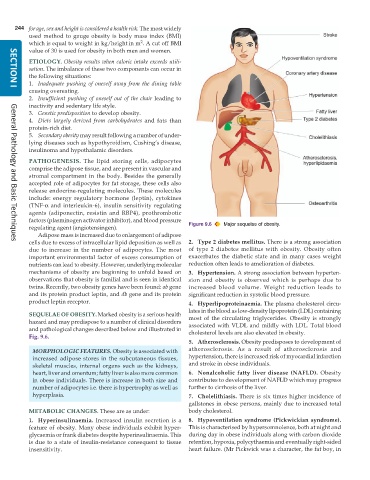
           regulating agent (angiotensingen).                  Figure 9.6  Major sequelae of obesity.
              Adipose mass is increased due to enlargement of adipose
           cells due to excess of intracellular lipid deposition as well as  2. Type 2 diabetes mellitus. There is a strong association
     General Pathology and Basic Techniques
           due to increase in the number of adipocytes. The most  of type 2 diabetes mellitus with obesity. Obesity often
           important environmental factor of excess consumption of  exacerbates the diabetic state and in many cases weight
           nutrients can lead to obesity. However, underlying molecular  reduction often leads to amelioration of diabetes.
           mechanisms of obesity are beginning to unfold based on  3. Hypertension. A strong association between hyperten-
           observations that obesity is familial and is seen in identical  sion and obesity is observed which is perhaps due to
           twins. Recently, two obesity genes have been found: ob gene  increased blood volume. Weight reduction leads to
           and its protein product leptin, and db gene and its protein  significant reduction in systolic blood pressure.
           product leptin receptor.                            4. Hyperlipoproteinaemia. The plasma cholesterol circu-
                                                               lates in the blood as low-density lipoprotein (LDL) containing
           SEQUELAE OF OBESITY. Marked obesity is a serious health  most of the circulating triglycerides. Obesity is strongly
           hazard and may predispose to a number of clinical disorders  associated with VLDL and mildly with LDL. Total blood
           and pathological changes described below and illustrated in  cholesterol levels are also elevated in obesity.
           Fig. 9.6.
                                                               5. Atherosclerosis. Obesity predisposes to development of
            MORPHOLOGIC FEATURES. Obesity is associated with   atherosclerosis. As a result of atherosclerosis and
            increased adipose stores in the subcutaneous tissues,  hypertension, there is increased risk of myocardial infarction
            skeletal muscles, internal organs such as the kidneys,  and stroke in obese individuals.
            heart, liver and omentum; fatty liver is also more common  6. Nonalcoholic fatty liver disease (NAFLD). Obesity
            in obese individuals. There is increase in both size and  contributes to development of NAFLD which may progress
            number of adipocytes i.e. there is hypertrophy as well as  further to cirrhosis of the liver.
            hyperplasia.                                       7. Cholelithiasis. There is six times higher incidence of
                                                               gallstones in obese persons, mainly due to increased total
           METABOLIC CHANGES. These are as under:              body cholesterol.
           1. Hyperinsulinaemia. Increased insulin secretion is a  8. Hypoventilation syndrome (Pickwickian syndrome).
           feature of obesity. Many obese individuals exhibit hyper-  This is characterised by hypersomnolence, both at night and
           glycaemia or frank diabetes despite hyperinsulinaemia. This  during day in obese individuals along with carbon dioxide
           is due to a state of insulin-resistance consequent to tissue  retention, hypoxia, polycythaemia and eventually right-sided
           insensitivity.                                      heart failure. (Mr Pickwick was a character, the fat boy, in

