


Page 261 - Textbook of Pathology, 6th Edition
P. 261
Charles Dickens’ Pickwick Papers. The term pickwickian 245
syndrome was first used by Sir William Osler for the sleep-
apnoea syndrome).
9. Osteoarthritis. These individuals are more prone to
develop degenerative joint disease due to wear and tear
following trauma to joints as a result of large body weight. CHAPTER 9
10. Cancer. Diet rich in fats, particularly derived from animal
fats and meats, is associated with higher incidence of cancers
of colon, breast, endometrium and prostate.
STARVATION
Starvation is a state of overall deprivation of nutrients. Its
causes may be the following:
i) deliberate fasting—religious or political;
ii) famine conditions in a country or community; or
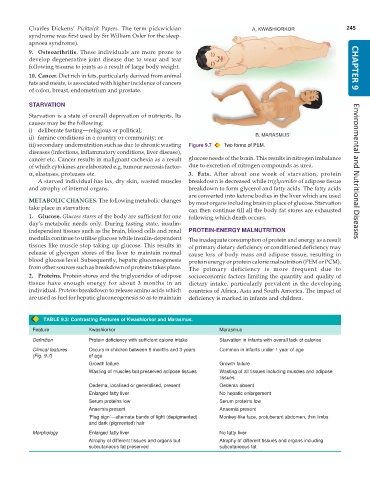
iii) secondary undernutrition such as due to chronic wasting Figure 9.7 Two forms of PEM.
diseases (infections, inflammatory conditions, liver disease),
cancer etc. Cancer results in malignant cachexia as a result glucose needs of the brain. This results in nitrogen imbalance
of which cytokines are elaborated e.g. tumour necrosis factor- due to excretion of nitrogen compounds as urea.
α, elastases, proteases etc. 3. Fats. After about one week of starvation, protein Environmental and Nutritional Diseases
A starved individual has lax, dry skin, wasted muscles breakdown is decreased while triglycerides of adipose tissue
and atrophy of internal organs. breakdown to form glycerol and fatty acids. The fatty acids
are converted into ketone bodies in the liver which are used
METABOLIC CHANGES. The following metabolic changes by most organs including brain in place of glucose. Starvation
take place in starvation: can then continue till all the body fat stores are exhausted
1. Glucose. Glucose stores of the body are sufficient for one following which death occurs.
day’s metabolic needs only. During fasting state, insulin-
independent tissues such as the brain, blood cells and renal PROTEIN-ENERGY MALNUTRITION
medulla continue to utilise glucose while insulin-dependent The inadequate consumption of protein and energy as a result
tissues like muscle stop taking up glucose. This results in of primary dietary deficiency or conditioned deficiency may
release of glycogen stores of the liver to maintain normal cause loss of body mass and adipose tissue, resulting in
blood glucose level. Subsequently, hepatic gluconeogenesis protein energy or protein calorie malnutrition (PEM or PCM).
from other sources such as breakdown of proteins takes place. The primary deficiency is more frequent due to
2. Proteins. Protein stores and the triglycerides of adipose socioeconomic factors limiting the quantity and quality of
tissue have enough energy for about 3 months in an dietary intake, particularly prevalent in the developing
individual. Proteins breakdown to release amino acids which countries of Africa, Asia and South America. The impact of
are used as fuel for hepatic gluconeogenesis so as to maintain deficiency is marked in infants and children.
TABLE 9.3: Contrasting Features of Kwashiorkor and Marasmus.
Feature Kwashiorkor Marasmus
Definition Protein deficiency with sufficient calorie intake Starvation in infants with overall lack of calories
Clinical features Occurs in children between 6 months and 3 years Common in infants under 1 year of age
(Fig. 9.7) of age
Growth failure Growth failure
Wasting of muscles but preserved adipose tissues Wasting of all tissues including muscles and adipose
tissues
Oedema, localised or generalised, present Oedema absent
Enlarged fatty liver No hepatic enlargement
Serum proteins low Serum proteins low
Anaemia present Anaemia present
‘Flag sign’—alternate bands of light (depigmented) Monkey-like face, protuberant abdomen, thin limbs
and dark (pigmented) hair
Morphology Enlarged fatty liver No fatty liver
Atrophy of different tissues and organs but Atrophy of different tissues and organs including
subcutaneous fat preserved subcutaneous fat

