


Page 262 - Textbook of Pathology, 6th Edition
P. 262
246 The spectrum of clinical syndromes produced as a result amounts of essential amino acids and fatty acids. Vitamins
of PEM includes the following (Fig. 9.7): do not play any part in production of energy.
1. Kwashiorkor which is related to protein deficiency though
calorie intake may be sufficient. ETIOLOGY OF VITAMIN DEFICIENCIES. In the develop-
ing countries, multiple deficiencies of vitamins and other
2. Marasmus is starvation in infants occurring due to overall nutrients are common due to generalised malnutrition of
lack of calories.
The salient features of the two conditions are contrasted dietary origin. In the developed countries, individual vitamin
in Table 9.3. However, it must be remembered that mixed deficiencies are noted more often, particularly in children,
adolescent, pregnant and lactating women, and in some due
forms of kwashiorkor-marasmus syndrome may also occur.
SECTION I
to poverty. General secondary causes of conditioned
nutritional deficiencies listed already above (i.e. interference
DISORDERS OF VITAMINS in ingestion, absorption, utilization, excretion) can result in
vitamin deficinecy in either case. Chronic alcoholism is a
Vitamins are organic substances which cannot be synthesised
common denominator in many of vitamin deficiencies. A few
within the body and are essential for maintenance of normal
structure and function of cells. Thus, these substances must be other noteworthy features about vitamins are as under:
provided in the human diet. Most of the vitamins are of plant 1. While both vitamin deficiency and excess may occur from
or animal origin so that they normally enter the body as another disease, the states of excess and deficiency
constituents of ingested plant food or animal food. They are themselves also cause disease.
required in minute amounts in contrast to the relatively large 2. Vitamins in high dose can be used as drugs.
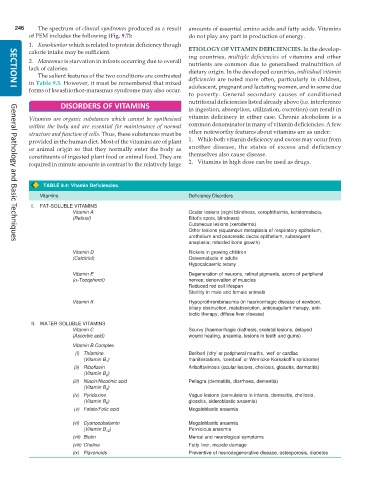
TABLE 9.4: Vitamin Deficiencies.
Vitamins Deficiency Disorders
I. FAT-SOLUBLE VITAMINS
Vitamin A Ocular lesions (night blindness, xerophthalmia, keratomalacia,
(Retinol) Bitot’s spots, blindness)
Cutaneous lesions (xeroderma)
Other lesions (squamous metaplasia of respiratory epithelium,
urothelium and pancreatic ductal epithelium, subsequent
anaplasia; retarded bone growth)
General Pathology and Basic Techniques
Vitamin D Rickets in growing children
(Calcitriol) Osteomalacia in adults
Hypocalcaemic tetany
Vitamin E Degeneration of neurons, retinal pigments, axons of peripheral
(α-Tocopherol) nerves; denervation of muscles
Reduced red cell lifespan
Sterility in male and female animals
Vitamin K Hypoprothrombinaemia (in haemorrhagic disease of newborn,
biliary obstruction, malabsorption, anticoagulant therapy, anti-
biotic therapy, diffuse liver disease)
II. WATER-SOLUBLE VITAMINS
Vitamin C Scurvy (haemorrhagic diathesis, skeletal lesions, delayed
(Ascorbic acid) wound healing, anaemia, lesions in teeth and gums)
Vitamin B Complex
(i) Thiamine Beriberi (‘dry’ or peripheral neuritis, ‘wet’ or cardiac
(Vitamin B 1 ) manifestations, ‘cerebral’ or Wernicke-Korsakoff’s syndrome)
(ii) Riboflavin Ariboflavinosis (ocular lesions, cheilosis, glossitis, dermatitis)
(Vitamin B )
2
(iii) Niacin/Nicotinic acid Pellagra (dermatitis, diarrhoea, dementia)
(Vitamin B )
3
(iv) Pyridoxine Vague lesions (convulsions in infants, dermatitis, cheilosis,
(Vitamin B 6 ) glossitis, sideroblastic anaemia)
(v) Folate/Folic acid Megaloblastic anaemia
(vi) Cyanocobalamin Megaloblastic anaemia
(Vitamin B ) Pernicious anaemia
12
(vii) Biotin Mental and neurological symptoms
(viii) Choline Fatty liver, muscle damage
(ix) Flavonoids Preventive of neurodegenerative disease, osteoporosis, diabetes

