


Page 522 - Textbook of Pathology, 6th Edition
P. 522
506


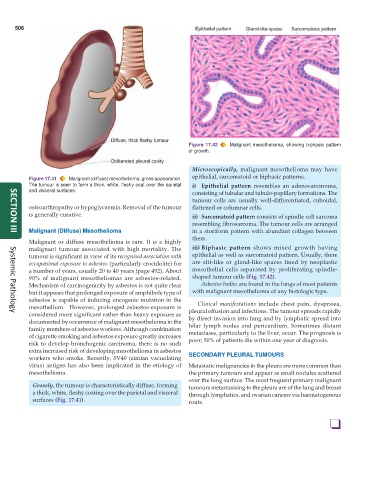
                                                               Figure 17.42  Malignant mesothelioma, showing biphasic pattern
                                                               of growth.


                                                                 Microscopically, malignant mesothelioma may have
                                                                 epithelial, sarcomatoid or biphasic patterns.
           Figure 17.41  Malignant (diffuse) mesothelioma, gross appearance.
           The tumour is seen to form a thick, white, fleshy coat over the parietal  i) Epithelial pattern resembles an adenocarcinoma,
           and visceral surfaces.
                                                                 consisting of tubular and tubulo-papillary formations. The
                                                                 tumour cells are usually well-differentiated, cuboidal,
           osteoarthropathy or hypoglycaemia. Removal of the tumour  flattened or columnar cells.
           is generally curative.                                ii) Sarcomatoid pattern consists of spindle cell sarcoma
                                                                 resembling fibrosarcoma. The tumour cells are arranged
           Malignant (Diffuse) Mesothelioma                      in a storiform pattern with abundant collagen between
     SECTION III
                                                                 them.
           Malignant or diffuse mesothelioma is rare. It is a highly
           malignant tumour associated with high mortality. The  iii) Biphasic pattern shows mixed growth having
           tumour is significant in view of its recognised association with  epithelial as well as sarcomatoid pattern. Usually, there
           occupational exposure to asbestos (particularly crocidolite) for  are slit-like or gland-like spaces lined by neoplastic
           a number of years, usually 20 to 40 years (page 492). About  mesothelial cells separated by proliferating spindle-
           90% of malignant mesotheliomas are asbestos-related.  shaped tumour cells (Fig. 17.42).
           Mechanism of carcinogenicity by asbestos is not quite clear  Asbestos bodies are found in the lungs of most patients
           but it appears that prolonged exposure of amphibole type of  with malignant mesothelioma of any histologic type.
           asbestos is capable of inducing oncogenic mutation in the  Clinical manifestations  include chest pain, dyspnoea,
           mesothelium.  However, prolonged asbestos-exposure is  pleural effusion and infections. The tumour spreads rapidly
           considered more significant rather than heavy exposure as  by direct invasion into lung and by lymphatic spread into
     Systemic Pathology
           documented by occurrence of malignant mesothelioma in the  hilar lymph nodes and pericardium. Sometimes distant
           family members of asbestos workers. Although combination  metastases, particularly to the liver, occur. The prognosis is
           of cigarette smoking and asbestos exposure greatly increases  poor; 50% of patients die within one year of diagnosis.
           risk to develop bronchogenic carcinoma, there is no such
           extra increased risk of developing mesothelioma in asbestos
           workers who smoke. Recently, SV40 (simian vacuolating  SECONDARY PLEURAL TUMOURS
           virus) antigen has also been implicated in the etiology of  Metastatic malignancies in the pleura are more common than
           mesothelioma.                                       the primary tumours and appear as small nodules scattered
                                                               over the lung surface. The most frequent primary malignant
            Grossly, the tumour is characteristically diffuse, forming  tumours metastasising to the pleura are of the lung and breast
            a thick, white, fleshy coating over the parietal and visceral  through lymphatics, and ovarian cancers via haematogenous
            surfaces (Fig. 17.41).                             route.


                                                                                                              ❑

