


Page 523 - Textbook of Pathology, 6th Edition
P. 523
507


            Chapter 18                          The Eye, ENT and Neck
            Chapter 18


                                  EYE

           NORMAL STRUCTURE
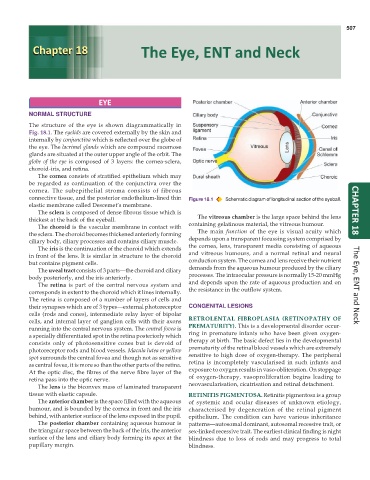
           The structure of the eye is shown diagrammatically in
           Fig. 18.1. The eyelids are covered externally by the skin and
           internally by conjunctiva which is reflected over the globe of
           the eye. The lacrimal glands which are compound racemose
           glands are situated at the outer upper angle of the orbit. The
           globe of the eye is composed of 3 layers: the cornea-sclera,
           choroid-iris, and retina.
              The cornea consists of stratified epithelium which may
           be regarded as continuation of the conjunctiva over the
           cornea. The subepithelial stroma consists of fibrous
           connective tissue, and the posterior endothelium-lined thin  Figure 18.1  Schematic diagram of longitudinal section of the eyeball.
           elastic membrane called Descemet’s membrane.
              The sclera is composed of dense fibrous tissue which is                                                 CHAPTER 18
           thickest at the back of the eyeball.                   The vitreous chamber is the large space behind the lens
              The choroid is the vascular membrane in contact with  containing gelatinous material, the vitreous humour.
           the sclera. The choroid becomes thickened anteriorly forming  The main function  of the eye is visual acuity which
           ciliary body, ciliary processes and contains ciliary muscle.  depends upon a transparent focussing system comprised by
              The iris is the continuation of the choroid which extends  the cornea, lens, transparent media consisting of aqueous
           in front of the lens. It is similar in structure to the choroid  and vitreous humours, and a normal retinal and neural
           but contains pigment cells.                         conduction system. The cornea and lens receive their nutrient
              The uveal tract consists of 3 parts—the choroid and ciliary  demands from the aqueous humour produced by the ciliary
           body posteriorly, and the iris anteriorly.          processes. The intraocular pressure is normally 15-20 mmHg
              The retina is part of the central nervous system and  and depends upon the rate of aqueous production and on  The Eye, ENT and Neck
           corresponds in extent to the choroid which it lines internally.  the resistance in the outflow system.
           The retina is composed of a number of layers of cells and
           their synapses which are of 3 types—external photoreceptor  CONGENITAL LESIONS
           cells (rods and cones), intermediate relay layer of bipolar
           cells, and internal layer of ganglion cells with their axons  RETROLENTAL FIBROPLASIA (RETINOPATHY OF
           running into the central nervous system. The central fovea is  PREMATURITY). This is a developmental disorder occur-
           a specially differentiated spot in the retina posteriorly which  ring in premature infants who have been given oxygen-
           consists only of photosensitive cones but is devoid of  therapy at birth. The basic defect lies in the developmental
           photoreceptor rods and blood vessels. Macula lutea or yellow  prematurity of the retinal blood vessels which are extremely
           spot surrounds the central fovea and though not as sensitive  sensitive to high dose of oxygen-therapy. The peripheral
           as central fovea, it is more so than the other parts of the retina.  retina is incompletely vascularised in such infants and
           At the optic disc, the fibres of the nerve fibre layer of the  exposure to oxygen results in vaso-obliteration. On stoppage
           retina pass into the optic nerve.                   of oxygen-therapy, vasoproliferation begins leading to
              The lens is the biconvex mass of laminated transparent  neovascularisation, cicatrisation and retinal detachment.
           tissue with elastic capsule.                        RETINITIS PIGMENTOSA. Retinitis pigmentosa is a group
              The anterior chamber is the space filled with the aqueous  of systemic and ocular diseases of unknown etiology,
           humour, and is bounded by the cornea in front and the iris  characterised by degeneration of the retinal pigment
           behind, with anterior surface of the lens exposed in the pupil.  epithelium. The condition can have various inheritance
              The posterior chamber containing aqueous humour is  patterns—autosomal dominant, autosomal recessive trait, or
           the triangular space between the back of the iris, the anterior  sex-linked recessive trait. The earliest clinical finding is night
           surface of the lens and ciliary body forming its apex at the  blindness due to loss of rods and may progress to total
           pupillary margin.                                   blindness.

