


Page 524 - Textbook of Pathology, 6th Edition
P. 524
508
            Histologically, there is disappearance of rods and cones
            of the photoreceptor layer of the retina, degeneration of
            retinal pigment epithelium and ingrowth of glial
            membrane on the optic disc.


           INFLAMMATORY CONDITIONS
           Inflammatory conditions of the eye are designated according
           to the tissue affected. ‘Uveitis’ is the commonly used term
           for the ocular inflammation of the uveal tract which is the
           most vascular tissue of the eye. However, specific designation
           is used for the type of tissue of eye inflamed. Some of the
           important types are described below.
           STYE (HORDEOLUM). Stye or ‘external hordeolum’ is an
           acute suppurative inflammation of the sebaceous glands of
           Zeis, the apocrine glands of Moll and the eyelash follicles.
           The less common ‘internal hordeolum’ is an acute
           suppurative inflammation of the meibomian glands.
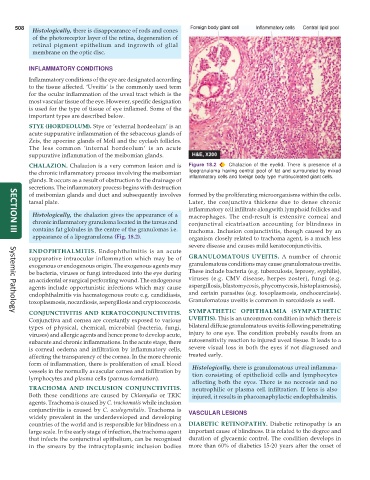
           CHALAZION. Chalazion is a very common lesion and is  Figure 18.2  Chalazion of the eyelid. There is presence of a
           the chronic inflammatory process involving the meibomian  lipogranuloma having central pool of fat and surrounded by mixed
           glands. It occurs as a result of obstruction to the drainage of  inflammatory cells and foreign body type multinucleated giant cells.
           secretions. The inflammatory process begins with destruction
           of meibomian glands and duct and subsequently involves  formed by the proliferating microorganisms within the cells.
           tarsal plate.                                       Later, the conjunctiva thickens due to dense chronic
                                                               inflammatory cell infiltrate alongwith lymphoid follicles and
            Histologically, the chalazion gives the appearance of a  macrophages. The end-result is extensive corneal and
            chronic inflammatory granuloma located in the tarsus and  conjunctival cicatrisation accounting for blindness in
            contains fat globules in the centre of the granulomas i.e.  trachoma. Inclusion conjunctivitis, though caused by an
     SECTION III
            appearance of a lipogranuloma (Fig. 18.2).         organism closely related to trachoma agent, is a much less
                                                               severe disease and causes mild keratoconjunctivitis.
           ENDOPHTHALMITIS.  Endophthalmitis is an acute
           suppurative intraocular inflammation which may be of  GRANULOMATOUS UVEITIS.  A number of chronic
           exogenous or endogenous origin. The exogenous agents may  granulomatous conditions may cause granulomatous uveitis.
           be bacteria, viruses or fungi introduced into the eye during  These include bacteria (e.g. tuberculosis, leprosy, syphilis),
           an accidental or surgical perforating wound. The endogenous  viruses (e.g. CMV disease, herpes zoster), fungi (e.g.
           agents include opportunistic infections which may cause  aspergillosis, blastomycosis, phycomycosis, histoplasmosis),
           endophthalmitis via haematogenous route e.g. candidiasis,  and certain parasites (e.g. toxoplasmosis, onchocerciasis).
           toxoplasmosis, nocardiosis, aspergillosis and cryptococcosis.  Granulomatous uveitis is common in sarcoidosis as well.
           CONJUNCTIVITIS AND KERATOCONJUNCTIVITIS.            SYMPATHETIC OPHTHALMIA (SYMPATHETIC
     Systemic Pathology
           Conjunctiva and cornea are constantly exposed to various  UVEITIS). This is an uncommon condition in which there is
           types of physical, chemical, microbial (bacteria, fungi,  bilateral diffuse granulomatous uveitis following penetrating
           viruses) and allergic agents and hence prone to develop acute,  injury to one eye. The condition probably results from an
           subacute and chronic inflammations. In the acute stage, there  autosensitivity reaction to injured uveal tissue. It leads to a
           is corneal oedema and infiltration by inflammatory cells,  severe visual loss in both the eyes if not diagnosed and
           affecting the transparency of the cornea. In the more chronic  treated early.
           form of inflammation, there is proliferation of small blood  Histologically, there is granulomatous uveal inflamma-
           vessels in the normally avascular cornea and infiltration by  tion consisting of epithelioid cells and lymphocytes
           lymphocytes and plasma cells (pannus formation).
                                                                 affecting both the eyes. There is no necrosis and no
           TRACHOMA AND INCLUSION CONJUNCTIVITIS.                neutrophilic or plasma cell infiltration. If lens is also
           Both these conditions are caused by  Chlamydia or TRIC  injured, it results in phacoanaphylactic endophthalmitis.
           agents. Trachoma is caused by C. trachomatis while inclusion
           conjunctivitis is caused by C. oculogenitalis. Trachoma is  VASCULAR LESIONS
           widely prevalent in the underdeveloped and developing
           countries of the world and is responsible for blindness on a  DIABETIC RETINOPATHY.  Diabetic retinopathy is an
           large scale. In the early stage of infection, the trachoma agent  important cause of blindness. It is related to the degree and
           that infects the conjunctival epithelium, can be recognised  duration of glycaemic control. The condition develops in
           in the smears by the intracytoplasmic inclusion bodies  more than 60% of diabetics 15-20 years after the onset of

