


Page 525 - Textbook of Pathology, 6th Edition
P. 525
509


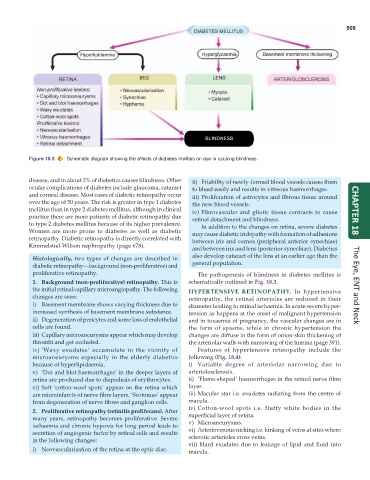
           Figure 18.3  Schematic diagram showing the effects of diabetes mellitus on eye in causing blindness.


           disease, and in about 2% of diabetics causes blindness. Other  ii) Friability of newly-formed blood vessels causes them
           ocular complications of diabetes include glaucoma, cataract  to bleed easily and results in vitreous haemorrhages.
           and corneal disease. Most cases of diabetic retinopathy occur  iii) Proliferation of astrocytes and fibrous tissue around
           over the age of 50 years. The risk is greater in type 1 diabetes  the new blood vessels.
           mellitus than in type 2 diabetes mellitus, although in clinical  iv) Fibrovascular and gliotic tissue contracts to cause  CHAPTER 18
           practice there are more patients of diabetic retinopathy due  retinal detachment and blindness.
           to type 2 diabetes mellitus because of its higher prevalence.  In addition to the changes on retina, severe diabetes
           Women are more prone to diabetes as well as diabetic  may cause diabetic iridopathy with formation of adhesions
           retinopathy. Diabetic retinopathy is directly correlated with  between iris and cornea (peripheral anterior synechiae)
           Kimmelstiel-Wilson nephropathy (page 678).
                                                                 and between iris and lens (posterior synechiae). Diabetics
                                                                 also develop cataract of the lens at an earlier age than the
            Histologically, two types of changes are described in
            diabetic retinopathy—background (non-proliferative) and  general population.
            proliferative retinopathy.                            The pathogenesis of blindness in diabetes mellitus is
            1. Background (non-proliferative) retinopathy. This is  schematically outlined in Fig. 18.3.
            the initial retinal capillary microangiopathy. The following  HYPERTENSIVE RETINOPATHY.  In hypertensive  The Eye, ENT and Neck
            changes are seen:                                  retinopathy, the retinal arterioles are reduced in their
            i) Basement membrane shows varying thickness due to  diameter leading to retinal ischaemia. In acute severe hyper-
            increased synthesis of basement membrane substance.  tension as happens at the onset of malignant hypertension
            ii) Degeneration of pericytes and some loss of endothelial  and in toxaemia of pregnancy, the vascular changes are in
            cells are found.                                   the form of spasms, while in chronic hypertension the
            iii) Capillary microaneurysms appear which may develop  changes are diffuse in the form of onion-skin thickening of
            thrombi and get occluded.                          the arteriolar walls with narrowing of the lumina (page 391).
            iv) ‘Waxy exudates’ accumulate in the vicinity of     Features of hypertensive retinopathy include the
            microaneurysms especially in the elderly diabetics  following (Fig. 18.4):
            because of hyperlipidaemia.                        i) Variable degree of arteriolar narrowing due to
            v) ‘Dot and blot haemorrhages’ in the deeper layers of  arteriolosclerosis.
            retina are produced due to diapedesis of erythrocytes.  ii) ‘Flame-shaped’ haemorrhages in the retinal nerve fibre
            vi) Soft ‘cotton-wool spots’ appear on the retina which  layer.
            are microinfarcts of nerve fibre layers. ‘Scotomas’ appear  iii) Macular star i.e. exudates radiating from the centre of
            from degeneration of nerve fibres and ganglion cells.  macula.
                                                               iv) Cotton-wool spots i.e. fluffy white bodies in the
            2. Proliferative retinopathy (retinitis proliferans). After  superficial layer of retina.
            many years, retinopathy becomes proliferative. Severe  v) Microaneurysms.
            ischaemia and chronic hypoxia for long period leads to  vi) Arteriovenous nicking i.e. kinking of veins at sites where
            secretion of angiogenic factor by retinal cells and results  sclerotic arterioles cross veins.
            in the following changes:                          vii) Hard exudates due to leakage of lipid and fluid into
            i) Neovascularisation of the retina at the optic disc.  macula.

