


Page 528 - Textbook of Pathology, 6th Edition
P. 528
512


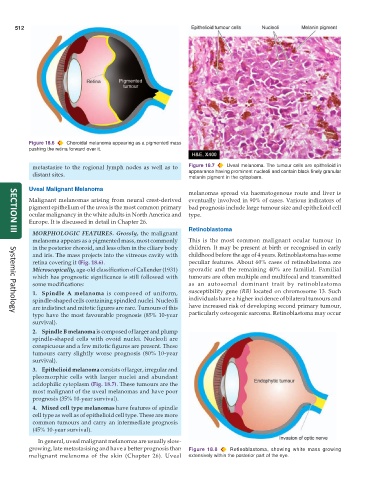
           Figure 18.6  Choroidal melanoma appearing as a pigmented mass
           pushing the retina forward over it.


            metastasise to the regional lymph nodes as well as to  Figure 18.7  Uveal melanoma. The tumour cells are epithelioid in
            distant sites.                                     appearance having prominent nucleoli and contain black finely granular
                                                               melanin pigment in the cytoplasm.
           Uveal Malignant Melanoma
                                                               melanomas spread via haematogenous route and liver is
           Malignant melanomas arising from neural crest-derived  eventually involved in 90% of cases. Various indicators of
           pigment epithelium of the uvea is the most common primary  bad prognosis include large tumour size and epithelioid cell
           ocular malignancy in the white adults in North America and  type.
           Europe. It is discussed in detail in Chapter 26.
                                                               Retinoblastoma
            MORPHOLOGIC FEATURES. Grossly, the malignant
     SECTION III
            melanoma appears as a pigmented mass, most commonly  This is the most common malignant ocular tumour in
            in the posterior choroid, and less often in the ciliary body  children. It may be present at birth or recognised in early
            and iris. The mass projects into the vitreous cavity with  childhood before the age of 4 years. Retinoblastoma has some
            retina covering it (Fig. 18.6).                    peculiar features. About 60% cases of retinoblastoma are
            Microscopically, age-old classification of Callender (1931)  sporadic and the remaining 40% are familial. Familial
            which has prognostic significance is still followed with  tumours are often multiple and multifocal and transmitted
            some modifications:                                as an autosomal dominant trait by retinoblastoma
            1. Spindle A melanoma is composed of uniform,      susceptibility gene (RB) located on chromosome 13. Such
            spindle-shaped cells containing spindled nuclei. Nucleoli  individuals have a higher incidence of bilateral tumours and
            are indistinct and mitotic figures are rare. Tumours of this  have increased risk of developing second primary tumour,
            type have the most favourable prognosis (85% 10-year  particularly osteogenic sarcoma. Retinoblastoma may occur
     Systemic Pathology
            survival).
            2. Spindle B melanoma is composed of larger and plump
            spindle-shaped cells with ovoid nuclei. Nucleoli are
            conspicuous and a few mitotic figures are present. These
            tumours carry slightly worse prognosis (80% 10-year
            survival).
            3. Epithelioid melanoma consists of larger, irregular and
            pleomorphic cells with larger nuclei and abundant
            acidophilic cytoplasm (Fig. 18.7). These tumours are the
            most malignant of the uveal melanomas and have poor
            prognosis (35% 10-year survival).
            4. Mixed cell type melanomas have features of spindle
            cell type as well as of epithelioid cell type. These are more
            common tumours and carry an intermediate prognosis
            (45% 10-year survival).
              In general, uveal malignant melanomas are usually slow-
           growing, late metastasising and have a better prognosis than  Figure 18.8  Retinoblastoma, showing white mass growing
           malignant melanoma of the skin (Chapter 26). Uveal  extensively within the posterior part of the eye.

