


Page 531 - Textbook of Pathology, 6th Edition
P. 531
NOSE AND PARANASAL SINUSES                    515
                                                               NORMAL STRUCTURE

                                                               The external nose and the septum are composed of bone and
                                                               cartilage. On the lateral wall of the nasal cavity, there is a
                                                               system of 3 ridges on each side known as conchae or
                                                               turbinates—the inferior, middle and superior. The nasal
                                                               accessory sinuses are air spaces in the bones of the skull and
                                                               communicate with the nasal cavity. They are the frontal air
                                                               sinus, maxillary air sinus and the anterior ethmoid air cells,
                                                               comprising the anterior group, while posterior ethmoidal cells
                                                               and sphenoidal sinus form the posterior group. The anterior
                                                               group drains into the middle meatus while the posterior
                                                               group drains into the superior meatus and the spheno-
                                                               ethmoidal recess. Nasal mucous membranes as well as the
                                                               lining of the nasal sinus are lined by respiratory epithelium
                                                               (pseudostratified columnar ciliated cells). Mucous and serous
                                                               glands underlie the mucous membrane. Besides, the upper
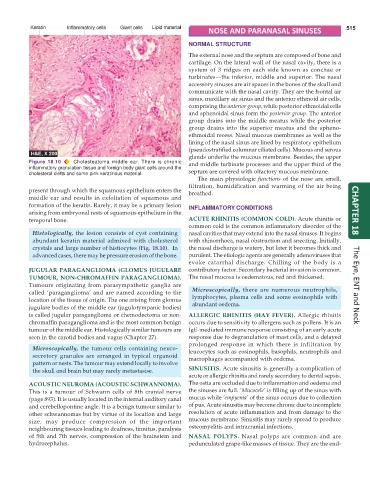
           Figure 18.10  Cholesteatoma middle ear.  There is chronic  and middle turbinate processes and the upper third of the
           inflammatory granulation tissue and foreign body giant cells around the  septum are covered with olfactory mucous membrane.
           cholesterol clefts and some pink keratinous material.
                                                                  The main physiologic  functions of the nose are smell,
                                                               filtration, humidification and warming of the air being
           present through which the squamous epithelium enters the  breathed.
           middle ear and results in exfoliation of squamous and
           formation of the keratin. Rarely, it may be a primary lesion  INFLAMMATORY CONDITIONS
           arising from embryonal rests of squamous epithelium in the                                                 CHAPTER 18
           temporal bone.                                      ACUTE RHINITIS (COMMON COLD). Acute rhinitis or
                                                               common cold is the common inflammatory disorder of the
            Histologically, the lesion consists of cyst containing  nasal cavities that may extend into the nasal sinuses. It begins
            abundant keratin material admixed with cholesterol  with rhinorrhoea, nasal obstruction and sneezing. Initially,
            crystals and large number of histiocytes (Fig. 18.10).  In  the nasal discharge is watery, but later it becomes thick and
            advanced cases, there may be pressure erosion of the bone.  purulent. The etiologic agents are generally adenoviruses that
                                                               evoke catarrhal discharge. Chilling of the body is a
           JUGULAR PARAGANGLIOMA (GLOMUS JUGULARE              contributory factor. Secondary bacterial invasion is common.
           TUMOUR, NON-CHROMAFFIN PARAGANGLIOMA).              The nasal mucosa is oedematous, red and thickened.
           Tumours originating from parasympathetic ganglia are                                                       The Eye, ENT and Neck
           called ‘paraganglioma’ and are named according to the  Microscopically, there are numerous neutrophils,
           location of the tissue of origin. The one arising from glomus  lymphocytes, plasma cells and some eosinophils with
           jugulare bodies of the middle ear (jugulotympanic bodies)  abundant oedema.
           is called jugular paraganglioma or chemodectoma or non-  ALLERGIC RHINITIS (HAY FEVER).  Allergic rhinitis
           chromaffin paraganglioma and is the most common benign  occurs due to sensitivity to allergens such as pollens. It is an
           tumour of the middle ear. Histologically similar tumours are  IgE-mediated immune response consisting of an early acute
           seen in the carotid bodies and vagus (Chapter 27).  response due to degranulation of mast cells, and a delayed
                                                               prolonged response in which there is infiltration by
            Microscopically, the tumour cells containing neuro-  leucocytes such as eosinophils, basophils, neutrophils and
            secretory granules are arranged in typical organoid  macrophages accompanied with oedema.
            pattern or nests. The tumour may extend locally to involve
            the skull and brain but may rarely metastasise.    SINUSITIS. Acute sinusitis is generally a complication of
                                                               acute or allergic rhinitis and rarely secondary to dental sepsis.
           ACOUSTIC NEUROMA (ACOUSTIC SCHWANNOMA).             The ostia are occluded due to inflammation and oedema and
           This is a tumour of Schwann cells of 8th cranial nerve  the sinuses are full. ‘Mucocele’ is filling up of the sinus with
           (page 893). It is usually located in the internal auditory canal  mucus while ‘empyema’ of the sinus occurs due to collection
           and cerebellopontine angle. It is a benign tumour similar to  of pus. Acute sinusitis may become chronic due to incomplete
           other schwannomas but by virtue of its location and large  resolution of acute inflammation and from damage to the
           size,  may produce compression of the important     mucous membrane. Sinusitis may rarely spread to produce
           neighbouring tissues leading to deafness, tinnitus, paralysis  osteomyelitis and intracranial infections.
           of 5th and 7th nerves, compression of the brainstem and  NASAL POLYPS. Nasal polyps are common and are
           hydrocephalus.                                      pedunculated grape-like masses of tissue. They are the end-

