


Page 532 - Textbook of Pathology, 6th Edition
P. 532
516                                                        respiratory epithelium which may show squamous
                                                                 metaplasia  (Fig. 18.11). Nasal polyps may have
                                                                 superimposed fungal infection.

                                                               RHINOSPORIDIOSIS. Rhinosporidiosis is caused by a
                                                               fungus, Rhinosporidium seeberi. Typically it occurs in a nasal
                                                               polyp but may be found in other locations like nasopharynx,
                                                               larynx and conjunctiva. The disease is common in India and
                                                               Sri Lanka and sporadic in other parts of the world.

                                                                 Microscopically, besides the structure of inflammatory
                                                                 or allergic polyp, large number of organisms of the size
                                                                 of erythrocytes with chitinous wall are seen in the thick-
                                                                 walled  sporangia. Each sporangium may contain a few
                                                                 thousand spores. On rupture of a sporangium, the spores
                                                                 are discharged into the submucosa or on to the surface of
                                                                 the mucosa. The intervening tissue consists of inflam-
                                                                 matory granulation tissue (plasma cells, lymphocytes,
                                                                 histiocytes, neutrophils) while the overlying epithelium
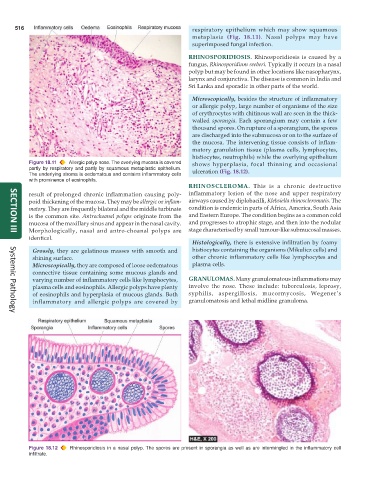
           Figure 18.11  Allergic polyp nose. The overlying mucosa is covered  shows hyperplasia, focal thinning and occasional
           partly by respiratory and partly by squamous metaplastic epithelium.  ulceration (Fig. 18.12).
           The underlying stroma is oedematous and contains inflammatory cells
           with prominence of eosinophils.
                                                               RHINOSCLEROMA.  This is a chronic destructive
           result of prolonged chronic inflammation causing poly-  inflammatory lesion of the nose and upper respiratory
           poid thickening of the mucosa. They may be allergic or inflam-  airways caused by diplobacilli, Klebsiella rhinoscleromatis. The
           matory. They are frequently bilateral and the middle turbinate  condition is endemic in parts of Africa, America, South Asia
           is the common site. Antrochoanal polyps originate from the  and Eastern Europe. The condition begins as a common cold
           mucosa of the maxillary sinus and appear in the nasal cavity.  and progresses to atrophic stage, and then into the nodular
           Morphologically, nasal and antro-choanal polyps are  stage characterised by small tumour-like submucosal masses.
     SECTION III
           identical.
                                                                 Histologically, there is extensive infiltration by foamy
            Grossly, they are gelatinous masses with smooth and  histiocytes containing the organisms (Mikulicz cells) and
            shining surface.                                     other chronic inflammatory cells like lymphocytes and
            Microscopically, they are composed of loose oedematous  plasma cells.
            connective tissue containing some mucous glands and
            varying number of inflammatory cells like lymphocytes,  GRANULOMAS. Many granulomatous inflammations may
            plasma cells and eosinophils. Allergic polyps have plenty  involve the nose. These include: tuberculosis, leprosy,
            of eosinophils and hyperplasia of mucous glands. Both  syphilis, aspergillosis, mucormycosis, Wegener’s
            inflammatory and allergic polyps are covered by    granulomatosis and lethal midline granuloma.
     Systemic Pathology


           Figure 18.12  Rhinosporidiosis in a nasal polyp. The spores are present in sporangia as well as are intermingled in the inflammatory cell
           infiltrate.

