


Page 534 - Textbook of Pathology, 6th Edition
P. 534
518 crypts are filled with debris and pus giving it follicular
           appearance. Chronic tonsillitis is caused by repeated attacks
           of acute tonsillitis in which case the tonsils are small and
           fibrosed. Acute tonsillitis may pass on to tissues adjacent to
           tonsils to form peritonsillar abscess or quinsy.

           PERITONSILLAR ABSCESS (QUINSY).  Peritonsillar
           abscess or quinsy occurs as a complication of acute tonsil-
           litis. The causative organisms are staphylococci or
           streptococci which are associated with infection of the tonsils.
           The patient complains of acute pain in the throat, trismus,
           difficulty in speech and inability to swallow. The glands
           behind the angle of the mandible are enlarged and tender.
           Besides the surgical management of the abscess, the patient
           must be advised  tonsillectomy because quinsy is frequently
           recurrent.

           RETROPHARYNGEAL ABSCESS. Formation of abscess in
           the soft tissue between the posterior wall of the pharynx and
           the vertebral column is called retropharyngeal abscess. It
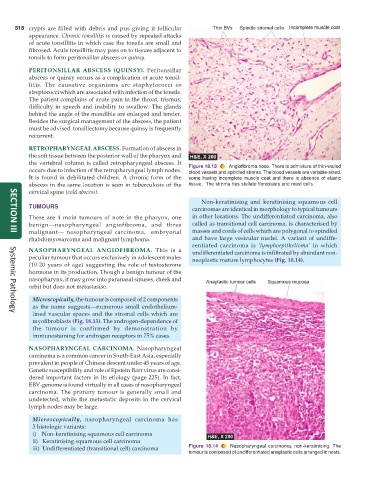
           occurs due to infection of the retropharyngeal lymph nodes.  Figure 18.13  Angiofibroma nose. There is admixture of thin-walled
                                                               blood vessels and spindled stroma. The blood vessels are variable-sized,
           It is found in debilitated children. A chronic form of the  some having incomplete muscle coat and there is absence of elastic
           abscess in the same location is seen in tuberculosis of the  tissue.  The stroma has stellate fibroblasts and mast cells.
           cervical spine (cold abscess).
                                                                    Non-keratinising and keratinising squamous cell
           TUMOURS                                               carcinomas are identical in morphology to typical tumours
           There are 4 main tumours of note in the pharynx, one  in other locations. The undifferentiated carcinoma, also
           benign—nasopharyngeal angiofibroma, and three         called as transitional cell carcinoma, is characterised by
           malignant— nasopharyngeal carcinoma,  embryonal       masses and cords of cells which are polygonal to spindled
     SECTION III
           rhabdomyosarcoma and malignant lymphoma.              and have large vesicular nuclei. A variant of undiffe-
                                                                 rentiated carcinoma is  ‘lymphoepithelioma’ in which
           NASOPHARYNGEAL ANGIOFIBROMA.  This is a               undifferentiated carcinoma is infiltrated by abundant non-
           peculiar tumour that occurs exclusively in adolescent males  neoplastic mature lymphocytes (Fig. 18.14).
           (10-20 years of age) suggesting the role of testosterone
           hormone in its production. Though a benign tumour of the
           nasopharynx, it may grow into paranasal sinuses, cheek and
           orbit but does not metastasise.

            Microscopically, the tumour is composed of 2 components
            as the name suggests—numerous small endothelium-
            lined vascular spaces and the stromal cells which are
     Systemic Pathology
            myofibroblasts (Fig. 18.13). The androgen-dependence of
            the tumour is confirmed by demonstration by
            immunostaining for androgen receptors in 75% cases.

           NASOPHARYNGEAL CARCINOMA.  Nasopharyngeal
           carcinoma is a common cancer in South-East Asia, especially
           prevalent in people of Chinese descent under 45 years of age.
           Genetic susceptibility and role of Epstein-Barr virus are consi-
           dered important factors in its etiology (page 225). In fact,
           EBV-genome is found virtually in all cases of nasopharyngeal
           carcinoma. The primary tumour is generally small and
           undetected, while the metastatic deposits in the cervical
           lymph nodes may be large.

            Microscopically, nasopharyngeal carcinoma has
            3 histologic variants:
            i)  Non-keratinising squamous cell carcinoma
            ii) Keratinising squamous cell carcinoma
            iii) Undifferentiated (transitional cell) carcinoma  Figure 18.14  Nasopharyngeal carcinoma, non-keratinising. The
                                                               tumour is composed of undifferentiated anaplastic cells arranged in nests.

