


Page 535 - Textbook of Pathology, 6th Edition
P. 535
The prognosis is usually fatal. Undifferentiated  TUMOURS                                             519
           carcinoma is radiosensitive.
                                                               Both benign and malignant tumours occur in the larynx. The
           EMBRYONAL RHABDOMYOSARCOMA. Also termed as          common examples of benign tumours are papillomas and
           botyroid rhabdomyosarcoma, this is one of the common  polyps, while laryngeal carcinoma is an important example
           malignant tumours in children but can also occur in adults.  amongst malignant tumours.
           The lesion is highly cellular and mitotically active. Other  LARYNGEAL PAPILLOMA AND PAPILLOMATOSIS.
           locations include vagina, orbit, middle ear, oral cavity,  Juvenile laryngeal papillomas are found in children or
           retroperitoneum and bile duct. It is discussed in detail on  adolescents and are often multiple, while the adults have
           page 867.
                                                               usually a single lesion. Multiple juvenile papillomas may
           MALIGNANT LYMPHOMA. The lymphoid tissue of the      undergo spontaneous regression at puberty. Human
           nasopharynx and tonsils may be the site for development of  papilloma virus (HPV type 11 and 6) has been implicated in
           malignant lymphomas which resemble similar tumours  the etiology of papillomas of the larynx.
           elsewhere in the body.
                                                                 Grossly, the lesions appear as warty growths on the true
                                                                 vocal cords, epiglottis and sometimes extend to the trachea
                               LARYNX                            and bronchi.
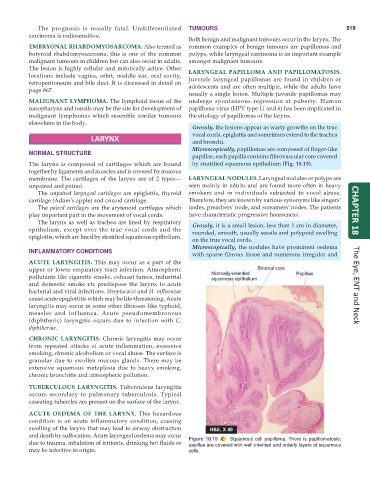
                                                                 Microscopically, papillomas are composed of finger-like
           NORMAL STRUCTURE
                                                                 papillae, each papilla contains fibrovascular core covered
           The larynx is composed of cartilages which are bound  by stratified squamous epithelium (Fig. 18.15).
           together by ligaments and muscles and is covered by mucous
           membrane. The cartilages of the larynx are of 2 types—  LARYNGEAL NODULES. Laryngeal nodules or polyps are
           unpaired and paired.                                seen mainly in adults and are found more often in heavy
              The  unpaired laryngeal cartilages are epiglottis, thyroid  smokers and in individuals subjected to vocal abuse.
           cartilage (Adam’s apple) and cricoid cartilage.     Therefore, they are known by various synonyms like singers’
              The paired cartilages are the arytenoid cartilages which  nodes, preachers’ node, and screamers’ nodes. The patients
           play important part in the movement of vocal cords.  have characteristic progressive hoarseness.           CHAPTER 18
              The larynx as well as trachea are lined by respiratory  Grossly, it is a small lesion, less than 1 cm in diameter,
           epithelium, except over the true vocal cords and the  rounded, smooth, usually sessile and polypoid swelling
           epiglottis, which are lined by stratified squamous epithelium.
                                                                 on the true vocal cords.
                                                                 Microscopically, the nodules have prominent oedema
           INFLAMMATORY CONDITIONS
                                                                 with sparse fibrous tissue and numerous irregular and
           ACUTE LARYNGITIS.  This may occur as a part of the
           upper or lower respiratory tract infection. Atmospheric
           pollutants like cigarette smoke, exhaust fumes, industrial
           and domestic smoke etc predispose the larynx to acute                                                      The Eye, ENT and Neck
           bacterial and viral infections. Streptococci and H. influenzae
           cause acute epiglottitis which may be life-threatening. Acute
           laryngitis may occur in some other illnesses like typhoid,
           measles and influenza. Acute pseudomembranous
           (diphtheric) laryngitis occurs due to infection with  C.
           diphtheriae.
           CHRONIC LARYNGITIS. Chronic laryngitis may occur
           from repeated attacks of acute inflammation, excessive
           smoking, chronic alcoholism or vocal abuse. The surface is
           granular due to swollen mucous glands. There may be
           extensive squamous metaplasia due to heavy smoking,
           chronic bronchitis and atmospheric pollution.
           TUBERCULOUS LARYNGITIS.  Tuberculous laryngitis
           occurs secondary to pulmonary tuberculosis. Typical
           caseating tubercles are present on the surface of the larynx.

           ACUTE OEDEMA OF THE LARYNX.  This hazardous
           condition is an acute inflammatory condition, causing
           swelling of the larynx that may lead to airway obstruction
           and death by suffocation. Acute laryngeal oedema may occur  Figure 18.15  Squamous cell papilloma. There is papillomatosis;
           due to trauma, inhalation of irritants, drinking hot fluids or  papillae are covered with well oriented and orderly layers of squamous
           may be infective in origin.                         cells.

