


Page 541 - Textbook of Pathology, 6th Edition
P. 541
Microscopically, fibroma is composed of collagenic INCIDENCE. It occurs more frequently in males than 525
fibrous connective tissue covered by stratified squamous females. The lesions may be of variable size and appearance.
epithelium. The sites of predilection, in descending order of frequency,
are: cheek mucosa, angles of mouth, alveolar mucosa, tongue,
FIBROMATOSIS GINGIVAE. This is a fibrous overgrowth lip, hard and soft palate, and floor of the mouth. In about 4-
of unknown etiology involving the entire gingiva. Sometimes 6% cases of leukoplakia, carcinomatous change is reported.
the fibrous overgrowth is so much that the teeth are covered However, it is difficult to decide which white lesions may
by fibrous tissue. undergo malignant transformation, but speckled or nodular
TUMOURS OF MINOR SALIVARY GLANDS. Minor form is more likely to progress to malignancy. Therefore, it
salivary glands present in the oral cavity may sometimes be is desirable that all oral white patches be biopsied to exclude
the site of origin of salivary tumours similar to those seen in malignancy.
the major salivary glands (page 533). Pleomorphic adenoma ETIOLOGY. The etiological factors are similar to those
is a common example. suggested for carcinoma of the oral mucosa (discussed
GRANULAR CELL TUMOUR. Earlier called as granular cell below). It has the strongest association with the use of tobacco in
myoblastoma, it is benign tumour which now by electron various forms, e.g. in heavy smokers (especially in pipe and
microscopic studies is known to be mesenchymal in origin cigar smokers) and improves when smoking is discontinued,
than odontogenic. The most common location is the tongue and in those who chew tobacco as in paan, paan masaala,
but may occur in any other location on the oral cavity. It zarda, gutka etc. The condition is also known by other names
occurs exclusively in females. A similar lesion seen in infants such as smokers keratosis and stomatitis nicotina. Other
is termed as congenital epulis. etiological factors implicated are chronic friction such as with
ill-fitting dentures or jagged teeth, and local irritants like
Microscopically, the tumour is composed of large excessive consumption of alcohol and very hot and spicy
polyhedral cells with granular, acidophilic cytoplasm. The foods and beverages. A special variety of leukoplakia called
covering epithelium usually shows pronounced ‘hairy leukoplakia’ has been described in patients of AIDS and
pseudoepitheliomatous hyperplasia. has hairy or corrugated surface but is not related to CHAPTER 19
development of oral cancer.
OTHER RARE BENIGN TUMOURS. Some other rare
benign tumours which can occur in the oral soft tissues are:
neurilemmoma, neurofibroma, lipoma, giant cell granuloma, MORPHOLOGIC FEATURES. Grossly, the lesions of
rhabdomyoma, leiomyoma, solitary plasmacytoma, osteoma, leukoplakia may appear white, whitish-yellow, or red-
chondroma, naevi and vascular oral lesions seen in hereditary velvety of more than 5 mm diameter and variable in
haemorrhagic telangiectasia (Osler-Rendu-Weber syndrome) appearance. They are usually circumscribed, slightly
and encephalofacial angiomatosis (Sturge-Weber syndrome). elevated, smooth or wrinkled, speckled or nodular.
Histologically, leukoplakia is of 2 types:
C. ORAL LEUKOPLAKIA (WHITE LESIONS)
1. Hyperkeratotic type. This is characterised by an
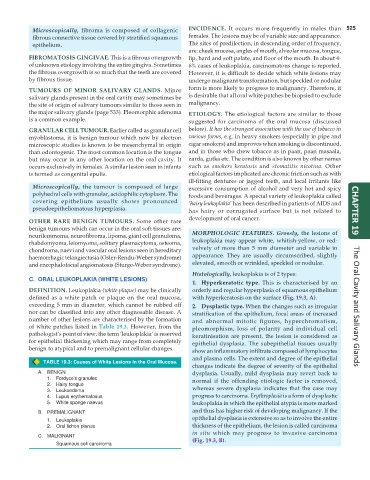
DEFINITION. Leukoplakia (white plaque) may be clinically orderly and regular hyperplasia of squamous epithelium
defined as a white patch or plaque on the oral mucosa, with hyperkeratosis on the surface (Fig. 19.3, A).
exceeding 5 mm in diameter, which cannot be rubbed off 2. Dysplastic type. When the changes such as irregular The Oral Cavity and Salivary Glands
nor can be classified into any other diagnosable disease. A stratification of the epithelium, focal areas of increased
number of other lesions are characterised by the formation and abnormal mitotic figures, hyperchromatism,
of white patches listed in Table 19.3. However, from the pleomorphism, loss of polarity and individual cell
pathologist’s point of view, the term ‘leukoplakia’ is reserved keratinisation are present, the lesion is considered as
for epithelial thickening which may range from completely epithelial dysplasia. The subepithelial tissues usually
benign to atypical and to premalignant cellular changes. show an inflammatory infiltrate composed of lymphocytes
and plasma cells. The extent and degree of the epithelial
TABLE 19.3: Causes of White Lesions in the Oral Mucosa.
changes indicate the degree of severity of the epithelial
A. BENIGN dysplasia. Usually, mild dysplasia may revert back to
1. Fordyce’s granules normal if the offending etiologic factor is removed,
2. Hairy tongue
3. Leukoedema whereas severe dysplasia indicates that the case may
4. Lupus erythematosus progress to carcinoma. Erythroplasia is a form of dysplastic
5. White sponge naevus leukoplakia in which the epithelial atypia is more marked
B. PREMALIGNANT and thus has higher risk of developing malignancy. If the
1. Leukoplakia epithelial dysplasia is extensive so as to involve the entire
2. Oral lichen planus thickness of the epithelium, the lesion is called carcinoma
in situ which may progress to invasive carcinoma
C. MALIGNANT
Squamous cell carcinoma (Fig. 19.3, B).

