


Page 542 - Textbook of Pathology, 6th Edition
P. 542
526


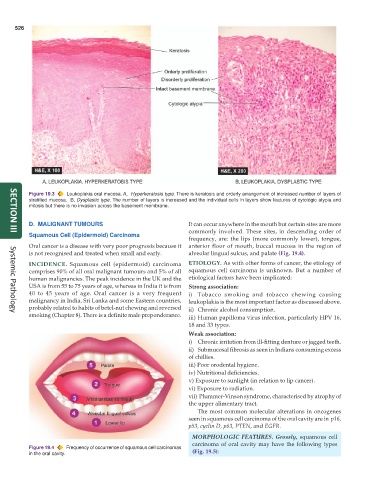
           Figure 19.3  Leukoplakia oral mucosa. A,  Hyperkeratosis type. There is keratosis and orderly arrangement of increased number of layers of
           stratified mucosa.  B, Dysplastic type. The number of layers is increased and the individual cells in layers show features of cytologic atypia and
           mitosis but there is no invasion across the basement membrane.


           D. MALIGNANT TUMOURS                                It can occur anywhere in the mouth but certain sites are more
                                                               commonly involved. These sites, in descending order of
           Squamous Cell (Epidermoid) Carcinoma
     SECTION III
                                                               frequency, are: the lips (more commonly lower), tongue,
           Oral cancer is a disease with very poor prognosis because it  anterior floor of mouth, buccal mucosa in the region of
           is not recognised and treated when small and early.  alveolar lingual sulcus, and palate (Fig. 19.4).
           INCIDENCE.  Squamous cell (epidermoid) carcinoma    ETIOLOGY. As with other forms of cancer, the etiology of
           comprises 90% of all oral malignant tumours and 5% of all  squamous cell carcinoma is unknown. But a number of
           human malignancies. The peak incidence in the UK and the  etiological factors have been implicated:
           USA is from 55 to 75 years of age, whereas in India it is from  Strong association:
           40 to 45 years of age. Oral cancer is a very frequent  i) Tobacco smoking and tobacco chewing causing
           malignancy in India, Sri Lanka and some Eastern countries,  leukoplakia is the most important factor as discussed above.
           probably related to habits of betel-nut chewing and reversed  ii) Chronic alcohol consumption.
           smoking (Chapter 8). There is a definite male preponderance.  iii) Human papilloma virus infection, particularly HPV 16,
     Systemic Pathology
                                                               18 and 33 types.
                                                               Weak association:
                                                               i) Chronic irritation from ill-fitting denture or jagged teeth.
                                                               ii) Submucosal fibrosis as seen in Indians consuming excess
                                                               of chillies.
                                                               iii) Poor orodental hygiene.
                                                               iv) Nutritional deficiencies.
                                                               v) Exposure to sunlight (in relation to lip cancer).
                                                               vi) Exposure to radiation.
                                                               vii) Plummer-Vinson syndrome, characterised by atrophy of
                                                               the upper alimentary tract.
                                                                  The most common molecular alterations in oncogenes
                                                               seen in squamous cell carcinoma of the oral cavity are in  p16,
                                                               p53, cyclin D, p63, PTEN, and EGFR.
                                                                 MORPHOLOGIC FEATURES. Grossly, squamous cell
                                                                 carcinoma of oral cavity may have the following types
           Figure 19.4  Frequency of occurrence of squamous cell carcinomas  (Fig. 19.5):
           in the oral cavity.

