


Page 543 - Textbook of Pathology, 6th Edition
P. 543
527


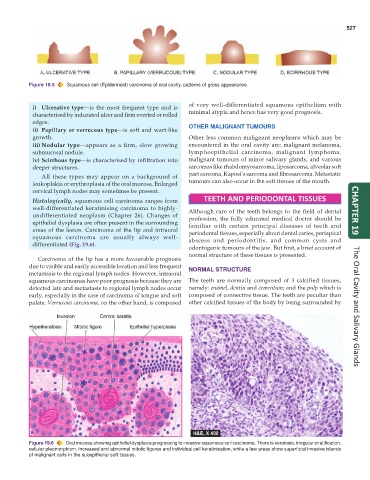
           Figure 19.5  Squamous cell (Epidermoid) carcinoma of oral cavity, patterns of gross appearance.


            i) Ulcerative type—is the most frequent type and is  of very well-differentiated squamous epithelium with
            characterised by indurated ulcer and firm everted or rolled  minimal atypia and hence has very good prognosis.
            edges.
            ii) Papillary or verrucous type—is soft and wart-like  OTHER MALIGNANT TUMOURS
            growth.                                            Other less common malignant neoplasms which may be
            iii) Nodular type—appears as a firm, slow growing  encountered in the oral cavity are: malignant melanoma,
            submucosal nodule.                                 lymphoepithelial carcinoma, malignant lymphoma,
            iv) Scirrhous type—is characterised by infiltration into  malignant tumours of minor salivary glands, and various
            deeper structures.                                 sarcomas like rhabdomyosarcoma, liposarcoma, alveolar soft
               All these types may appear on a background of   part sarcoma, Kaposi’s sarcoma and fibrosarcoma. Metastatic
            leukoplakia or erythroplasia of the oral mucosa. Enlarged  tumours can also occur in the soft tissues of the mouth.
            cervical lymph nodes may sometimes be present.
            Histologically, squamous cell carcinoma ranges from     TEETH AND PERIODONTAL TISSUES
            well-differentiated keratinising carcinoma to highly-  Although care of the teeth belongs to the field of dental  CHAPTER 19
            undifferentiated neoplasm (Chapter 26). Changes of  profession, the fully educated medical doctor should be
            epithelial dysplasia are often present in the surrounding  familiar with certain principal diseases of teeth and
            areas of the lesion. Carcinoma of the lip and intraoral  periodontal tissues, especially about dental caries, periapical
            squamous carcinoma are usually always well-        abscess and periodontitis, and common cysts and
            differentiated (Fig. 19.6).
                                                               odontogenic tumours of the jaw. But first, a brief account of
                                                               normal structure of these tissues is presented.
              Carcinoma of the lip has a more favourable prognosis
           due to visible and easily accessible location and less frequent  NORMAL STRUCTURE
           metastasis to the regional lymph nodes. However, intraoral
           squamous carcinomas have poor prognosis because they are  The teeth are normally composed of 3 calcified tissues,
           detected late and metastasis to regional lymph nodes occur  namely: enamel, dentin and cementum; and the pulp which is
           early, especially in the case of carcinoma of tongue and soft  composed of connective tissue. The teeth are peculiar than
           palate. Verrucous carcinoma, on the other hand, is composed  other calcified tissues of the body by being surrounded by  The Oral Cavity and Salivary Glands


           Figure 19.6  Oral mucosa showing epithelial dysplasia progressing to invasive squamous cell carcinoma. There is keratosis, irregular stratification,
           cellular pleomorphism, increased and abnormal mitotic figures and individual cell keratinisation, while a few areas show superficial invasive islands
           of malignant cells in the subepithelial soft tissues.

