


Page 544 - Textbook of Pathology, 6th Edition
P. 544
528                                                      Cementum is the portion of tooth which covers the dentin at
                                                               the root of tooth and is the site where periodontal ligament
                                                               is attached. Cementum is similar to bone in morphology and
                                                               composition.
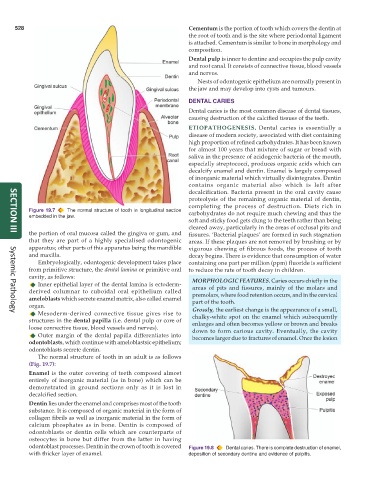
                                                               Dental pulp is inner to dentine and occupies the pulp cavity
                                                               and root canal. It consists of connective tissue, blood vessels
                                                               and nerves.
                                                                  Nests of odontogenic epithelium are normally present in
                                                               the jaw and may develop into cysts and tumours.
                                                               DENTAL CARIES
                                                               Dental caries is the most common disease of dental tissues,
                                                               causing destruction of the calcified tissues of the teeth.
                                                               ETIOPATHOGENESIS.  Dental caries is essentially a
                                                               disease of modern society, associated with diet containing
                                                               high proportion of refined carbohydrates. It has been known
                                                               for almost 100 years that mixture of sugar or bread with
                                                               saliva in the presence of acidogenic bacteria of the mouth,
                                                               especially streptococci, produces organic acids which can
                                                               decalcify enamel and dentin. Enamel is largely composed
                                                               of inorganic material which virtually disintegrates. Dentin
                                                               contains organic material also which is left after
                                                               decalcification. Bacteria present in the oral cavity cause
                                                               proteolysis of the remaining organic material of dentin,
                                                               completing the process of destruction. Diets rich in
           Figure 19.7  The normal structure of tooth in longitudinal section  carbohydrates do not require much chewing and thus the
           embedded in the jaw.
                                                               soft and sticky food gets clung to the teeth rather than being
                                                               cleared away, particularly in the areas of occlusal pits and
           the portion of oral mucosa called the gingiva or gum, and  fissures. ‘Bacterial plaques’ are formed in such stagnation
     SECTION III
           that they are part of a highly specialised odontogenic  areas. If these plaques are not removed by brushing or by
           apparatus; other parts of this apparatus being the mandible  vigorous chewing of fibrous foods, the process of tooth
           and maxilla.                                        decay begins. There is evidence that consumption of water
              Embryologically, odontogenic development takes place  containing one part per million (ppm) fluoride is sufficient
           from primitive structure, the dental lamina or primitive oral  to reduce the rate of tooth decay in children.
           cavity, as follows:                                   MORPHOLOGIC FEATURES. Caries occurs chiefly in the
              Inner epithelial layer of the dental lamina is ectoderm-
           derived columnar to cuboidal oral epithelium called   areas of pits and fissures, mainly of the molars and
                                                                 premolars, where food retention occurs, and in the cervical
           ameloblasts which secrete enamel matrix, also called enamel  part of the tooth.
           organ.                                                Grossly, the earliest change is the appearance of a small,
              Mesoderm-derived connective tissue gives rise to
     Systemic Pathology
           structures in the dental papilla (i.e. dental pulp or core of  chalky-white spot on the enamel which subsequently
                                                                 enlarges and often becomes yellow or brown and breaks
           loose connective tissue, blood vessels and nerves).   down to form carious cavity. Eventually, the cavity
              Outer margin of the dental papilla differentiates into  becomes larger due to fractures of enamel. Once the lesion
           odontoblasts, which continue with ameloblastsic epithelium;
           odontoblasts secrete dentin.
              The normal structure of tooth in an adult is as follows
           (Fig. 19.7):
           Enamel is the outer covering of teeth composed almost
           entirely of inorganic material (as in bone) which can be
           demonstrated in ground sections only as it is lost in
           decalcified section.
           Dentin lies under the enamel and comprises most of the tooth
           substance. It is composed of organic material in the form of
           collagen fibrils as well as inorganic material in the form of
           calcium phosphates as in bone. Dentin is composed of
           odontoblasts or dentin cells which are counterparts of
           osteocytes in bone but differ from the latter in having
           odontoblast processes. Dentin in the crown of tooth is covered  Figure 19.8  Dental caries. There is complete destruction of enamel,
           with thicker layer of enamel.                       deposition of secondary dentine and evidence of pulpitis.

