


Page 545 - Textbook of Pathology, 6th Edition
P. 545
reaches enamel-dentin junction, destruction of dentine periodontal pocket from which purulent discharge can be 529
also begins. expressed by digital pressure.
Microscopically, inflammation (pulpitis) and necrosis of Microscopically, chronic marginal gingivitis is charac-
pulp take place. There is evidence of reaction of the tooth terised by heavy chronic inflammatory cell infiltrate,
to the carious process in the form of secondary dentin, which destruction of collagen, and epithelial hyperplasia so as
is a layer of odontoblasts laid down under the original to line the pocket. Untreated chronic marginal gingivitis
dentine (Fig. 19.8). slowly progresses to chronic periodontitis or pyorrhoea in
which there is inflammatory destruction of deeper tissues.
SEQUELAE OF CARIES. Carious destruction of dental hard At this stage, progressive resorption of alveolar bone
tissues frequently produces pulpitis and other inflammatory occurs and the tooth ultimately gets detached.
lesions like apical granuloma and apical abscess. Less
common causes of these lesions are fracture of tooth and EPITHELIAL CYSTS OF THE JAW
accidental exposure of pulp by the dentist. The epithelium-lined cysts of dental tissue can have
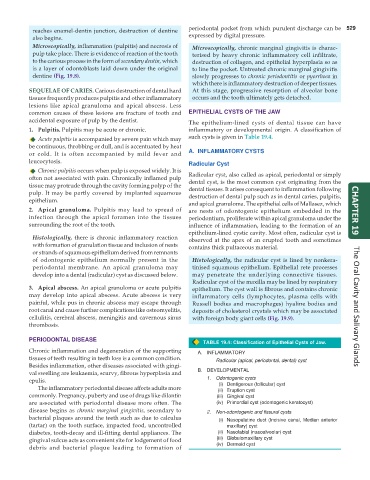
1. Pulpitis. Pulpitis may be acute or chronic. inflammatory or developmental origin. A classification of
Acute pulpitis is accompanied by severe pain which may such cysts is given in Table 19.4.
be continuous, throbbing or dull, and is accentuated by heat
or cold. It is often accompanied by mild fever and A. INFLAMMATORY CYSTS
leucocytosis. Radicular Cyst
Chronic pulpitis occurs when pulp is exposed widely. It is
often not associated with pain. Chronically inflamed pulp Radicular cyst, also called as apical, periodontal or simply
dental cyst, is the most common cyst originating from the
tissue may protrude through the cavity forming polyp of the dental tissues. It arises consequent to inflammation following
pulp. It may be partly covered by implanted squamous destruction of dental pulp such as in dental caries, pulpitis,
epithelium.
and apical granuloma. The epithelial cells of Mallasez, which
2. Apical granuloma. Pulpitis may lead to spread of are nests of odontogenic epithelium embedded in the CHAPTER 19
infection through the apical foramen into the tissues periodontium, proliferate within apical granuloma under the
surrounding the root of the tooth. influence of inflammation, leading to the formation of an
epithelium-lined cystic cavity. Most often, radicular cyst is
Histologically, there is chronic inflammatory reaction observed at the apex of an erupted tooth and sometimes
with formation of granulation tissue and inclusion of nests contains thick pultaceous material.
or strands of squamous epithelium derived from remnants
of odontogenic epithelium normally present in the Histologically, the radicular cyst is lined by nonkera-
periodontal membrane. An apical granuloma may tinised squamous epithelium. Epithelial rete processes
develop into a dental (radicular) cyst as discussed below. may penetrate the underlying connective tissues.
Radicular cyst of the maxilla may be lined by respiratory
3. Apical abscess. An apical granuloma or acute pulpitis epithelium. The cyst wall is fibrous and contains chronic
may develop into apical abscess. Acute abscess is very inflammatory cells (lymphocytes, plasma cells with
painful, while pus in chronic abscess may escape through Russell bodies and macrophages) hyaline bodies and
root canal and cause further complications like osteomyelitis, deposits of cholesterol crystals which may be associated The Oral Cavity and Salivary Glands
cellulitis, cerebral abscess, meningitis and cavernous sinus with foreign body giant cells (Fig. 19.9).
thrombosis.
PERIODONTAL DISEASE
TABLE 19.4: Classification of Epithelial Cysts of Jaw.
Chronic inflammation and degeneration of the supporting A. INFLAMMATORY
tissues of teeth resulting in teeth loss is a common condition. Radicular (apical, periodontal, dental) cyst
Besides inflammation, other diseases associated with gingi-
val swelling are leukaemia, scurvy, fibrous hyperplasia and B. DEVELOPMENTAL
epulis. 1. Odontogenic cysts
(i) Dentigerous (follicular) cyst
The inflammatory periodontal disease affects adults more (ii) Eruption cyst
commonly. Pregnancy, puberty and use of drugs like dilantin (iii) Gingival cyst
are associated with periodontal disease more often. The (iv) Primordial cyst (odontogenic keratocyst)
disease begins as chronic marginal gingivitis, secondary to 2. Non-odontogenic and fissural cysts
bacterial plaques around the teeth such as due to calculus (i) Nasopalatine duct (Incisive canal, Median anterior
(tartar) on the tooth surface, impacted food, uncontrolled maxillary) cyst
diabetes, tooth-decay and ill-fitting dental appliances. The (ii) Nasolabial (nasoalveolar) cyst
gingival sulcus acts as convenient site for lodgement of food (iii) Globulomaxillary cyst
debris and bacterial plaque leading to formation of (iv) Dermoid cyst

