


Page 549 - Textbook of Pathology, 6th Edition
P. 549
SALIVARY GLANDS                                                                            533

           NORMAL STRUCTURE

           There are two main groups of salivary glands—major and
           minor. The major salivary glands are the three paired glands:
           parotid, submandibular and sublingual. The minor salivary
           glands are numerous and are widely distributed in the
           mucosa of oral cavity. The main duct of the parotid gland
           drains into the oral cavity opposite the second maxillary
           molar, while the ducts of submandibular and sublingual
           glands empty in the floor of the mouth. At times, heterotopic
           salivary gland tissue may be present in lymph nodes near or
           within the parotid gland.
           Histologically, the salivary glands are tubuloalveolar glands
           and may contain mucous cells, serous cells, or both. The
           parotid gland is purely serous. The submandibular gland is
           mixed type but is predominantly serous, whereas the
           sublingual gland though also a mixed gland is predominantly
           mucous type. Similarly, minor salivary glands may also be
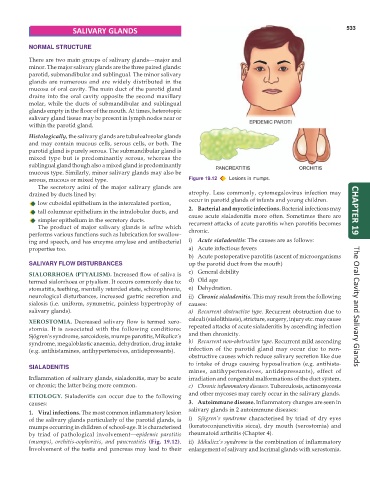
           serous, mucous or mixed type.                       Figure 19.12  Lesions in mumps.
              The secretory acini of the major salivary glands are
           drained by ducts lined by:                          atrophy. Less commonly, cytomegalovirus infection may
              low cuboidal epithelium in the intercalated portion,  occur in parotid glands of infants and young children.
              tall columnar epithelium in the intralobular ducts, and  2. Bacterial and mycotic infections. Bacterial infections may  CHAPTER 19
              simpler epithelium in the secretory ducts.       cause acute sialadenitis more often. Sometimes there are
                                                               recurrent attacks of acute parotitis when parotitis becomes
              The product of major salivary glands is  saliva which
           performs various functions such as lubrication for swallow-  chronic.
           ing and speech, and has enzyme amylase and antibacterial  i) Acute sialadenitis: The causes are as follows:
           properties too.                                     a) Acute infectious fevers
                                                               b) Acute postoperative parotitis (ascent of microorganisms
           SALIVARY FLOW DISTURBANCES                          up the parotid duct from the mouth)
           SIALORRHOEA (PTYALISM). Increased flow of saliva is  c) General debility
           termed sialorrhoea or ptyalism. It occurs commonly due to:  d) Old age
           stomatitis, teething, mentally retarded state, schizophrenia,  e) Dehydration.
           neurological disturbances, increased gastric secretion and  ii) Chronic sialadenitis. This may result from the following
           sialosis (i.e. uniform, symmetric, painless hypertrophy of  causes:                                        The Oral Cavity and Salivary Glands
           salivary glands).                                   a) Recurrent obstructive type. Recurrent obstruction due to
                                                               calculi (sialolithiasis), stricture, surgery, injury etc. may cause
           XEROSTOMIA. Decreased salivary flow is termed xero-
           stomia. It is associated with the following conditions:  repeated attacks of acute sialadenitis by ascending infection
           Sjögren’s syndrome, sarcoidosis, mumps parotitis, Mikulicz’s  and then chronicity.
           syndrome, megaloblastic anaemia, dehydration, drug intake  b) Recurrent non-obstructive type. Recurrent mild ascending
           (e.g. antihistamines, antihypertensives, antidepressants).  infection of the parotid gland may occur due to non-
                                                               obstructive causes which reduce salivary secretion like due
                                                               to intake of drugs causing hyposalivation (e.g. antihista-
           SIALADENITIS
                                                               mines, antihypertensives, antidepressants), effect of
           Inflammation of salivary glands, sialadenitis, may be acute  irradiation and congenital malformations of the duct system.
           or chronic; the latter being more common.           c) Chronic inflammatory diseases. Tuberculosis, actinomycosis
                                                               and other mycoses may rarely occur in the salivary glands.
           ETIOLOGY.  Sialadenitis can occur due to the following
           causes:                                             3. Autoimmune disease. Inflammatory changes are seen in
                                                               salivary glands in 2 autoimmune diseases:
           1. Viral infections. The most common inflammatory lesion
           of the salivary glands particularly of the parotid glands, is  i) Sjögren’s syndrome characterised by triad of dry eyes
           mumps occurring in children of school-age. It is characterised  (keratoconjunctivitis sicca), dry mouth (xerostomia) and
           by triad of pathological involvement—epidemic parotitis  rheumatoid arthritis (Chapter 4).
           (mumps), orchitis-oophoritis, and pancreatitis  (Fig. 19.12).  ii) Mikulicz’s syndrome is the combination of inflammatory
           Involvement of the testis and pancreas may lead to their  enlargement of salivary and lacrimal glands with xerostomia.

