


Page 550 - Textbook of Pathology, 6th Edition
P. 550
534 MORPHOLOGIC FEATURES. Irrespective of the under- TABLE 19.6: Classification of Salivary Gland Tumours.
lying etiology of sialadenitis, there is swelling of the A. BENIGN
affected salivary gland, usually restricted by the fibrous
capsule. Acute stage is generally associated with local 1. Adenomas
Pleomorphic adenoma (Mixed tumour) (65-80%)
i)
redness, pain and tenderness with purulent ductal ii) Monomorphic adenoma
discharge. Late chronic cases may be replaced by firm (a) Warthin’s tumour (Papillary cystadenoma
fibrous swelling. lymphomatosum, Adenolymphoma) (5-10%)
Microscopically, acute viral sialadenitis in mumps shows (b) Oxyphil adenoma (Oncocytomas) (< 1%)
swelling and cytoplasmic vacuolation of the acinar (c) Other types (Myoepithelioma, Basal cell
adenoma, Clear cell adenoma) (uncommon)
epithelial cells and degenerative changes in the ductal 2. Mesenchymal tumours (rare)
epithelium. There is interstitial oedema, fibrinoid degene-
ration of the collagen and dense infiltration by mono- B. MALIGNANT
nuclear cells (lymphocytes, plasma cells and macro- 1. Mucoepidermoid carcinoma (5-10%)
phages). Chronic and recurrent sialadenitis is characterised 2. Malignant mixed tumour
by increased lymphoid tissue in the interstitium, ii) i) Carcinoma in pleomorphic adenoma (2%)
Carcinosarcoma (rare)
progressive loss of secretory tissue and replacement by iii) Metastasising mixed salivary tumour (rare)
fibrosis. 3. Adenoid cystic carcinoma (cylindroma) (3-10%)
4. Acinic cell carcinoma (2-3%)
TUMOURS OF SALIVARY GLANDS 5. Adenocarcinoma (1-3%)
6. Epidermoid carcinoma (1-3%)
The major as well as minor salivary glands can give rise to a 7. Undifferentiated carcinoma (< 1%)
variety of benign and malignant tumours (Table 19.6). The 8. Miscellaneous (rare)
major glands, particularly the parotid glands (85%), are the
most common sites. Majority of parotid gland tumour (65- Pleomorphic Adenoma (Mixed Salivary Tumour)
85%) are benign, while in the other major and minor salivary This is the most common tumour of major (60-75%) and
glands 35-50% of the tumours are malignant. Most of the minor (50%) salivary glands. Pleomorphic adenoma is the
salivary gland tumours originate from the ductal lining commonest tumour in the parotid gland and occurs less often
epithelium and the underlying myoepithelial cells; a few arise in other major and minor salivary glands. The tumour is
from acini. Recurrent tumours of the parotid glands, due to commoner in women and is seen more frequently in 3rd to
SECTION III
their location, are often associated with facial palsy and 5th decades of life. The tumour is solitary, smooth-surfaced
obvious scarring following surgical treatment.
but sometimes nodular, painless and slow-growing. It is often
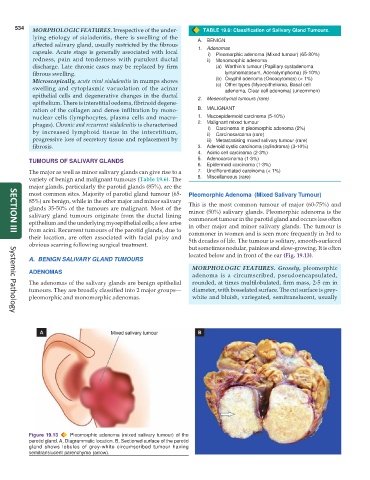
located below and in front of the ear (Fig. 19.13).
A. BENIGN SALIVARY GLAND TUMOURS
MORPHOLOGIC FEATURES. Grossly, pleomorphic
ADENOMAS
adenoma is a circumscribed, pseudoencapsulated,
The adenomas of the salivary glands are benign epithelial rounded, at times multilobulated, firm mass, 2-5 cm in
tumours. They are broadly classified into 2 major groups— diameter, with bosselated surface. The cut surface is grey-
pleomorphic and monomorphic adenomas. white and bluish, variegated, semitranslucent, usually
Systemic Pathology
Figure 19.13 Pleomorphic adenoma (mixed salivary tumour) of the
parotid gland. A, Diagrammatic location. B, Sectioned surface of the parotid
gland shows lobules of grey-white circumscribed tumour having
semitranslucent parenchyma (arrow).

