


Page 551 - Textbook of Pathology, 6th Edition
P. 551
535


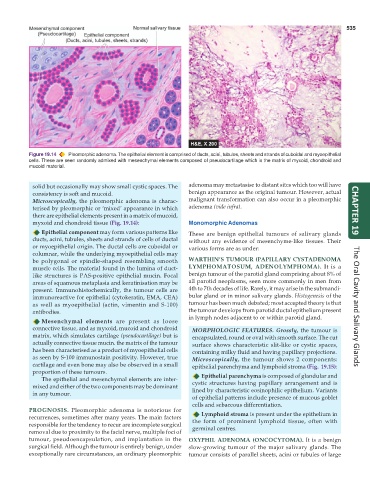
           Figure 19.14  Pleomorphic adenoma. The epithelial element is comprised of ducts, acini, tubules, sheets and strands of cuboidal and myoepithelial
           cells. These are seen randomly admixed with mesenchymal elements composed of pseudocartilage which is the matrix of myxoid, chondroid and
           mucoid material.


            solid but occasionally may show small cystic spaces. The  adenoma may metastasise to distant sites which too will have
            consistency is soft and mucoid.                    benign appearance as the original tumour. However, actual
            Microscopically, the pleomorphic adenoma is charac-  malignant transformation can also occur in a pleomorphic
            terised by pleomorphic or ‘mixed’ appearance in which  adenoma (vide infra).                             CHAPTER 19
            there are epithelial elements present in a matrix of mucoid,
            myxoid and chondroid tissue (Fig. 19.14):          Monomorphic Adenomas
               Epithelial component may form various patterns like  These are benign epithelial tumours of salivary glands
            ducts, acini, tubules, sheets and strands of cells of ductal  without any evidence of mesenchyme-like tissues. Their
            or myoepithelial origin. The ductal cells are cuboidal or  various forms are as under:
            columnar, while the underlying myoepithelial cells may
            be polygonal or spindle-shaped resembling smooth   WARTHIN’S TUMOUR (PAPILLARY CYSTADENOMA
            muscle cells. The material found in the lumina of duct-  LYMPHOMATOSUM, ADENOLYMPHOMA).  It is a
            like structures is PAS-positive epithelial mucin. Focal  benign tumour of the parotid gland comprising about 8% of
            areas of squamous metaplasia and keratinisation may be  all parotid neoplasms, seen more commonly in men from
            present. Immunohistochemically, the tumour cells are  4th to 7th decades of life. Rarely, it may arise in the submandi-
            immunoreactive for epithelial (cytokeratin, EMA, CEA)  bular gland or in minor salivary glands. Histogenesis of the
            as well as myoepithelial (actin, vimentin and S-100)  tumour has been much debated; most accepted theory is that  The Oral Cavity and Salivary Glands
            antibodies.                                        the tumour develops from parotid ductal epithelium present
                                                               in lymph nodes adjacent to or within parotid gland.
               Mesenchymal elements are present as loose
            connective tissue, and as myxoid, mucoid and chondroid  MORPHOLOGIC FEATURES. Grossly, the tumour is
            matrix, which simulates cartilage (pseudocartilage) but is  encapsulated, round or oval with smooth surface. The cut
            actually connective tissue mucin. the matrix of the tumour  surface shows characteristic slit-like or cystic spaces,
            has been characterised as a product of myoepithelial cells  containing milky fluid and having papillary projections.
            as seen by S-100 immunostain positivity. However, true  Microscopically, the tumour shows 2 components:
            cartilage and even bone may also be observed in a small  epithelial parenchyma and lymphoid stroma (Fig.  19.15):
            proportion of these tumours.                            Epithelial parenchyma is composed of glandular and
               The epithelial and mesenchymal elements are inter-
            mixed and either of the two components may be dominant  cystic structures having papillary arrangement and is
                                                                 lined by characteristic eosinophilic epithelium. Variants
            in any tumour.
                                                                 of epithelial patterns include presence of mucous goblet
                                                                 cells and sebaceous differentiation.
           PROGNOSIS.  Pleomorphic adenoma is notorious for         Lymphoid stroma is present under the epithelium in
           recurrences, sometimes after many years. The main factors  the form of prominent lymphoid tissue, often with
           responsible for the tendency to recur are incomplete surgical  germinal centres.
           removal due to proximity to the facial nerve, multiple foci of
           tumour, pseudoencapsulation, and implantation in the  OXYPHIL ADENOMA (ONCOCYTOMA). It is a benign
           surgical field. Although the tumour is entirely benign, under  slow-growing tumour of the major salivary glands. The
           exceptionally rare circumstances, an ordinary pleomorphic  tumour consists of parallel sheets, acini or tubules of large

