


Page 552 - Textbook of Pathology, 6th Edition
P. 552
536


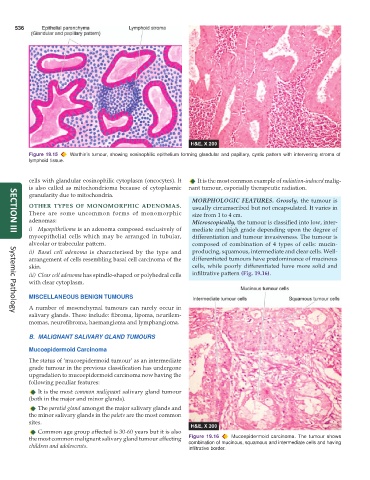
           Figure 19.15  Warthin’s tumour, showing eosinophilic epithelium forming glandular and papillary, cystic pattern with intervening stroma of
           lymphoid tissue.


           cells with glandular eosinophilic cytoplasm (oncocytes). It  It is the most common example of radiation-induced malig-
           is also called as mitochondrioma because of cytoplasmic  nant tumour, especially therapeutic radiation.
           granularity due to mitochondria.
                                                                 MORPHOLOGIC FEATURES. Grossly, the tumour is
           OTHER TYPES OF MONOMORPHIC ADENOMAS.                  usually circumscribed but not encapsulated. It varies in
           There are some uncommon forms of monomorphic          size from 1 to 4 cm.
           adenomas:                                             Microscopically, the tumour is classified into low, inter-
           i) Myoepithelioma is an adenoma composed exclusively of  mediate and high grade depending upon the degree of
           myoepithelial cells which may be arranged in tubular,  differentiation and tumour invasiveness. The tumour is
     SECTION III
           alveolar or trabecular pattern.                       composed of combination of 4 types of cells: mucin-
           ii) Basal cell adenoma is characterised by the type and  producing, squamous, intermediate and clear cells. Well-
           arrangement of cells resembling basal cell carcinoma of the  differentiated tumours have predominance of mucinous
           skin.                                                 cells, while poorly differentiated have more solid and
           iii) Clear cell adenoma has spindle-shaped or polyhedral cells  infiltrative pattern (Fig. 19.16).
           with clear cytoplasm.
           MISCELLANEOUS BENIGN TUMOURS

           A number of mesenchymal tumours can rarely occur in
           salivary glands. These include: fibroma, lipoma, neurilem-
     Systemic Pathology
           momas, neurofibroma, haemangioma and lymphangioma.

           B. MALIGNANT SALIVARY GLAND TUMOURS
           Mucoepidermoid Carcinoma

           The status of ‘mucoepidermoid tumour’ as an intermediate
           grade tumour in the previous classification has undergone
           upgradation to mucoepidermoid carcinoma now having the
           following peculiar features:
              It is the most common malignant salivary gland tumour
           (both in the major and minor glands).
              The parotid gland amongst the major salivary glands and
           the minor salivary glands in the palate are the most common
           sites.
              Common age group affected is 30-60 years but it is also
           the most common malignant salivary gland tumour affecting  Figure 19.16  Mucoepidermoid carcinoma. The tumour shows
                                                               combination of mucinous, squamous and intermediate cells and having
           children and adolescents.                           infiltrative border.

