


Page 555 - Textbook of Pathology, 6th Edition
P. 555
hernia in 98% of cases. The condition is diagnosed radio-                                                539
           logically in about 5% of apparently normal asymptomatic
           individuals. In symptomatic cases, especially the elderly
           women, the clinical features are heartburn (retrosternal
           burning sensation) and regurgitation of gastric juice into the
           mouth, both of which are worsened due to heavy work, lifting
           weights and excessive bending.
           ETIOLOGY. The basic defect is the failure of the muscle
           fibres of the diaphragm that form the margin of the
           oesophageal hiatus. This occurs due to shortening of the
           oesophagus which may be congenital or acquired.
              Congenitally short oesophagus may be the cause of
           hiatus hernia in a small proportion of cases.
              More commonly, it is acquired due to secondary factors
           which cause fibrous scarring of the oesophagus as follows:
           a) Degeneration of muscle due to aging.             Figure 20.2  Oesophageal webs and rings.
           b) Increased intra-abdominal pressure such as in pregnancy,
           abdominal tumours etc.                                 Congenital diverticula occur either at the upper end of
           c) Recurrent oesophageal regurgitation and spasm causing  the oesophagus or at the bifurcation of trachea.
           inflammation and fibrosis.                             Acquired diverticula may be of 2 types:
           d) Increase in fatty tissue in obese people causing decreased  a) Pulsion (Zenker’s) type—is seen in the region of hypo-
           muscular elasticity of diaphragm.                   pharynx and occurs due to oesophageal obstruction such as
                                                               due to chronic oesophagitis, carcinoma etc. The mucosa and
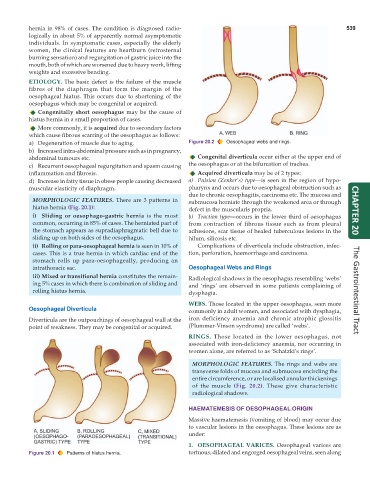
            MORPHOLOGIC FEATURES. There are 3 patterns in      submucosa herniate through the weakened area or through
            hiatus hernia (Fig. 20.1):                         defect in the muscularis propria.
            i) Sliding or oesophago-gastric hernia is the most  b) Traction type—occurs in the lower third of oesophagus  CHAPTER 20
            common, occurring in 85% of cases. The herniated part of  from contraction of fibrous tissue such as from pleural
            the stomach appears as supradiaphragmatic bell due to  adhesions, scar tissue of healed tuberculous lesions in the
            sliding up on both sides of the oesophagus.        hilum, silicosis etc.
            ii) Rolling or para-oesophageal hernia is seen in 10% of  Complications of diverticula include obstruction, infec-
            cases. This is a true hernia in which cardiac end of the  tion, perforation, haemorrhage and carcinoma.
            stomach rolls up para-oesophageally, producing an
            intrathoracic sac.                                 Oesophageal Webs and Rings
            iii) Mixed or transitional hernia constitutes the remain-  Radiological shadows in the oesophagus resembling ‘webs’
            ing 5% cases in which there is combination of sliding and  and ‘rings’ are observed in some patients complaining of
            rolling hiatus hernia.                             dysphagia.                                             The Gastrointestinal Tract

                                                               WEBS. Those located in the upper oesophagus, seen more
           Oesophageal Diverticula                             commonly in adult women, and associated with dysphagia,
           Diverticula are the outpouchings of oesophageal wall at the  iron deficiency anaemia and chronic atrophic glossitis
           point of weakness. They may be congenital or acquired.  (Plummer-Vinson syndrome) are called ‘webs’.
                                                               RINGS.  Those located in the lower oesophagus, not
                                                               associated with iron-deficiency anaemia, nor occurring in
                                                               women alone, are referred to as ‘Schatzki’s rings’.
                                                                 MORPHOLOGIC FEATURES. The rings and webs are
                                                                 transverse folds of mucosa and submucosa encircling the
                                                                 entire circumference, or are localised annular thickenings
                                                                 of the muscle  (Fig. 20.2). These give characteristic
                                                                 radiological shadows.


                                                               HAEMATEMESIS OF OESOPHAGEAL ORIGIN
                                                               Massive haematemesis (vomiting of blood) may occur due
                                                               to vascular lesions in the oesophagus. These lesions are as
                                                               under:
                                                               1. OESOPHAGEAL VARICES. Oesophageal varices are
           Figure 20.1  Patterns of hiatus hernia.             tortuous, dilated and engorged oesophageal veins, seen along

