


Page 556 - Textbook of Pathology, 6th Edition
P. 556
540 the longitudinal axis of oesophagus. They occur as a result  of chronic disease such as nodularity, strictures,
           of elevated pressure in the portal venous system, most  ulcerations and erosions.
           commonly in cirrhosis of the liver (Chapter 22). Less common  Microscopically, the reflux changes in the distal
           causes are: portal vein thrombosis, hepatic vein thrombosis  oesophagus include basal cell hyperplasia and deep
           (Budd-Chiari syndrome) and pylephlebitis. The lesions occur  elongation of the papillae touching close to the surface
           as a result of bypassing of portal venous blood from the liver  epithelium. Inflammatory changes vary according to the
           to the oesophageal venous plexus. The increased venous  stage of the disease. In early stage, mucosa and submucosa
           pressure in the superficial veins of the oesophagus may result  are infiltrated by some polymorphs and eosinophils; in
           in ulceration and massive bleeding.                   chronic stage, there is lymphocytic infiltration and fibrosis
           2. MALLORY-WEISS SYNDROME.  In this condition,        of all the layers of the oesophageal wall.
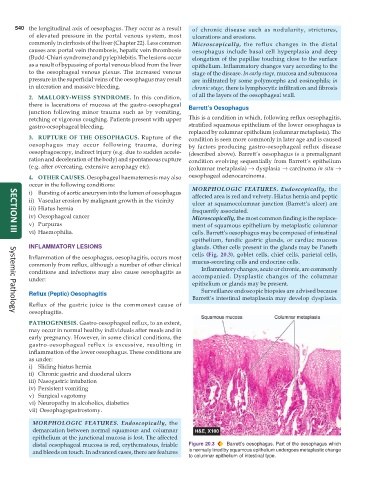
           there is lacerations of mucosa at the gastro-oesophageal  Barrett’s Oesophagus
           junction following minor trauma such as by vomiting,
           retching or vigorous coughing. Patients present with upper  This is a condition in which, following reflux oesophagitis,
           gastro-oesophageal bleeding.                        stratified squamous epithelium of the lower oesophagus is
                                                               replaced by columnar epithelium (columnar metaplasia). The
           3. RUPTURE OF THE OESOPHAGUS.  Rupture of the       condition is seen more commonly in later age and is caused
           oesophagus may occur following trauma, during       by factors producing gastro-oesophageal reflux disease
           oesophagoscopy, indirect injury (e.g. due to sudden accele-  (described above). Barrett’s oesophagus is a premalignant
           ration and deceleration of the body) and spontaneous rupture  condition evolving sequentially from Barrett’s epithelium
           (e.g. after overeating, extensive aerophagy etc).   (columnar metaplasia) → dysplasia → carcinoma in situ →
           4. OTHER CAUSES. Oesophageal haematemesis may also  oesophageal adenocarcinoma.
           occur in the following conditions:
           i) Bursting of aortic aneurysm into the lumen of oesophagus  MORPHOLOGIC FEATURES. Endoscopically,  the
                                                                 affected area is red and velvety. Hiatus hernia and peptic
           ii) Vascular erosion by malignant growth in the vicinity  ulcer at squamocolumnar junction (Barrett’s ulcer) are
           iii) Hiatus hernia                                    frequently associated.
           iv) Oesophageal cancer                                Microscopically, the most common finding is the replace-
           v) Purpuras                                           ment of squamous epithelium by metaplastic columnar
           vi) Haemophilia.                                      cells. Barrett’s oesophagus may be composed of intestinal
     SECTION III
                                                                 epithelium, fundic gastric glands, or cardiac mucous
           INFLAMMATORY LESIONS                                  glands. Other cells present in the glands may be Paneth
                                                                 cells  (Fig. 20.3), goblet cells, chief cells, parietal cells,
           Inflammation of the oesophagus, oesophagitis, occurs most
           commonly from reflux, although a number of other clinical  mucus-secreting cells and endocrine cells.
           conditions and infections may also cause oesophagitis as  Inflammatory changes, acute or chronic, are commonly
           under:                                                accompanied. Dysplastic changes of the columnar
                                                                 epithelium or glands may be present.
                                                                    Surveillance endoscopic biopsies are advised because
           Reflux (Peptic) Oesophagitis
                                                                 Barrett’s intestinal metaplasaia may develop dysplasia.
           Reflux of the gastric juice is the commonest cause of
           oesophagitis.
     Systemic Pathology
           PATHOGENESIS. Gastro-oesophageal reflux, to an extent,
           may occur in normal healthy individuals after meals and in
           early pregnancy. However, in some clinical conditions, the
           gastro-oesophageal reflux is excessive, resulting in
           inflammation of the lower oesophagus. These conditions are
           as under:
           i) Sliding hiatus hernia
           ii) Chronic gastric and duodenal ulcers
           iii) Nasogastric intubation
           iv) Persistent vomiting
           v) Surgical vagotomy
           vi) Neuropathy in alcoholics, diabetics
           vii) Oesophagogastrostomy.
            MORPHOLOGIC FEATURES.  Endoscopically,  the
            demarcation between normal squamous and columnar
            epithelium at the junctional mucosa is lost. The affected
            distal oesophageal mucosa is red, erythematous, friable  Figure 20.3  Barrett’s oesophagus. Part of the oesophagus which
            and bleeds on touch. In advanced cases, there are features  is normally lined by squamous epithelium undergoes metaplastic change
                                                               to columnar epithelium of intestinal type.

