


Page 557 - Textbook of Pathology, 6th Edition
P. 557
High-grade dysplasia may progress to invasive      men over 50 years of age. Prognosis is dismal: with standard  541
            adenocarcinoma of the oesophagus in up to 20% cases.  methods of therapy (surgical resection and/or irradiation),
                                                               70% of the patients die within one year of diagnosis. Five-
           Infectious Oesophagitis                             year survival rate is 5-10%.
           A number of opportunistic infections in immunosuppressed  ETIOLOGY.  Although exact etiology of carcinoma of the
           individuals can cause oesophagitis. Some of these agents are  oesophagus is not known, a number of conditions and factors
           as follows:                                         have been implicated as under:
           i) Candida (Monilial) oesophagitis
           ii) Herpes simplex (Herpetic) oesophagitis          1. Diet and personal habits:
           iii) Cytomegalovirus                                i) Heavy smoking
           iv) Tuberculosis.                                   ii) Alcohol consumption
                                                               iii) Intake of foods contaminated with fungus
           Other Causes of Oesophagitis                        iv) Nutritional deficiency of vitamins and trace elements.
           i) Eosinophilic oesophagitis caused by radiation, corrosives  2. Oesophageal disorders:
           ii) Intake of certain drugs (anticholinergic drugs,  i) Oesophagitis (especially Barrett’s oesophagus in
           doxycycline, tetracycline)                          adenocarcinoma)
           iii) Ingestion of hot, irritating fluids            ii) Achalasia
           iv) Crohn’s disease                                 iii) Hiatus hernia
           v) Various vesiculobullous skin diseases.           iv) Diverticula
                                                               v) Plummer-Vinson syndrome.
           TUMOURS OF OESOPHAGUS                               3. Other factors:
           Benign tumours of the oesophagus are uncommon and small  i) Race—more common in the Chinese and Japanese than
           in size (less than 3 cm). The epithelial benign tumours project  in Western races; more frequent in blacks than whites.
           as intraluminal masses arising from squamous epithelium  ii) Family history—association with tylosis (keratosis
           (squamous cell papilloma), or from columnar epithelium  palmaris et plantaris).                            CHAPTER 20
           (adenoma). The stromal or mesenchymal benign tumours are  iii) Genetic factors—predisposition with coeliac disease,
           intramural masses such as leiomyoma and others like lipoma,  epidermolysis bullosa, tylosis.
           fibroma, neurofibroma, rhabdomyoma, lymphangioma and  iv) HPV infection—is the recent addition in etiologic factors.
           haemangioma.                                           At molecular level, abnormality of p53 tumour suppressor
              For all practical purposes, malignant tumours of the oeso-  gene has been found associated with a number of above risk
           phagus are carcinomas because sarcomas such as      factors, notably with consumption of tobacco and alcohol,
           leiomyosarcoma and fibrosarcoma occur with extreme rarity.  and in cases having proven Barrett’s oesophagus.
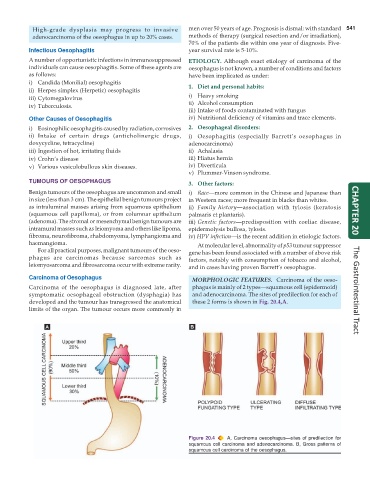
           Carcinoma of Oesophagus                               MORPHOLOGIC FEATURES.  Carcinoma of the oeso-
           Carcinoma of the oesophagus is diagnosed late, after  phagus is mainly of 2 types—squamous cell (epidermoid)
           symptomatic oesophageal obstruction (dysphagia) has   and adenocarcinoma. The sites of predilection for each of  The Gastrointestinal Tract
           developed and the tumour has transgressed the anatomical  these 2 forms is shown in Fig. 20.4,A.
           limits of the organ. The tumour occurs more commonly in


                                                               Figure 20.4  A, Carcinoma oesophagus—sites of predilection for
                                                               squamous cell carcinoma and adenocarcinoma. B, Gross patterns of
                                                               squamous cell carcinoma of the oesophagus.

