


Page 558 - Textbook of Pathology, 6th Edition
P. 558
542


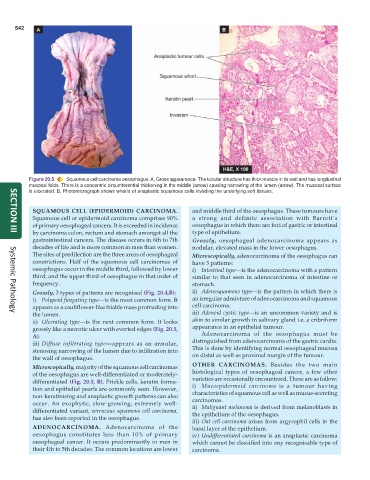
           Figure 20.5  Squamous cell carcinoma oesophagus. A, Gross appearance. The tubular structure has thick muscle in its wall and has longitudinal
           mucosal folds. There is a concentric circumferential thickening in the middle (arrow) causing narrowing of the lumen (arrow). The mucosal surface
           is ulcerated. B, Photomicrograph shows whorls of anaplastic squamous cells invading the underlying soft tissues.


            SQUAMOUS CELL (EPIDERMOID) CARCINOMA.                and middle third of the oesophagus. These tumours have
            Squamous cell or epidermoid carcinoma comprises 90%  a strong and definite association with Barrett’s
            of primary oesophageal cancers. It is exceeded in incidence  oesophagus in which there are foci of gastric or intestinal
            by carcinoma colon, rectum and stomach amongst all the  type of epithelium.
     SECTION III
            gastrointestinal cancers. The disease occurs in 6th to 7th  Grossly, oesophageal adenocarcinoma appears as
            decades of life and is more common in men than women.  nodular, elevated mass in the lower oesophagus.
            The sites of predilection are the three areas of oesophageal  Microscopically, adenocarcinoma of the oesophagus can
            constrictions. Half of the squamous cell carcinomas of  have 3 patterns:
            oesophagus occur in the middle third, followed by lower  i) Intestinal type—is the adenocarcinoma with a pattern
            third, and the upper third of oesophagus in that order of  similar to that seen in adenocarcinoma of intestine or
            frequency.                                           stomach.
            Grossly, 3 types of patterns are recognised (Fig. 20.4,B):  ii) Adenosquamous type—is the pattern in which there is
            i) Polypoid fungating type—is the most common form. It  an irregular admixture of adenocarcinoma and squamous
            appears as a cauliflower-like friable mass protruding into  cell carcinoma.
            the lumen.                                           iii) Adenoid cystic type—is an uncommon variety and is
     Systemic Pathology
            ii) Ulcerating type—is the next common form. It looks  akin to similar growth in salivary gland i.e. a cribriform
            grossly like a necrotic ulcer with everted edges (Fig. 20.5,  appearance in an epithelial tumour.
            A).                                                     Adenocarcinoma of the oesophagus must be
            iii) Diffuse infiltrating type—appears as an annular,  distinguished from adenocarcinoma of the gastric cardia.
            stenosing narrowing of the lumen due to infiltration into  This is done by identifying normal oesophageal mucosa
            the wall of oesophagus.                              on distal as well as proximal margin of the tumour.
            Microscopically, majority of the squamous cell carcinomas  OTHER CARCINOMAS. Besides the two main
            of the oesophagus are well-differentiated or moderately-  histological types of oesophageal cancer, a few other
            differentiated (Fig. 20.5, B). Prickle cells, keratin forma-  varieties are occasionally encountered. These are as follow:
            tion and epithelial pearls are commonly seen. However,  i) Mucoepidermoid carcinoma is a tumour having
            non-keratinising and anaplastic growth patterns can also  characteristics of squamous cell as well as mucus-secreting
                                                                 carcinomas.
            occur. An exophytic, slow-growing, extremely well-   ii) Malignant melanoma is derived from melanoblasts in
            differentiated variant, verrucous squamous cell carcinoma,  the epithelium of the oesophagus.
            has also been reported in the oesophagus.
                                                                 iii) Oat cell carcinoma arises from argyrophil cells in the
            ADENOCARCINOMA. Adenocarcinoma of the                basal layer of the epithelium.
            oesophagus constitutes less than 10% of primary      iv) Undifferentiated carcinoma is an anaplastic carcinoma
            oesophageal cancer. It occurs predominantly in men in  which cannot be classified into any recognisable type of
            their 4th to 5th decades. The common locations are lower  carcinoma.

