


Page 559 - Textbook of Pathology, 6th Edition
P. 559
v) Carcinosarcoma consists of malignant epithelial as well  is inner concavity on the right, while the greater curvature is  543
            as sarcomatous components.                         the outer convexity on the left side of the stomach.
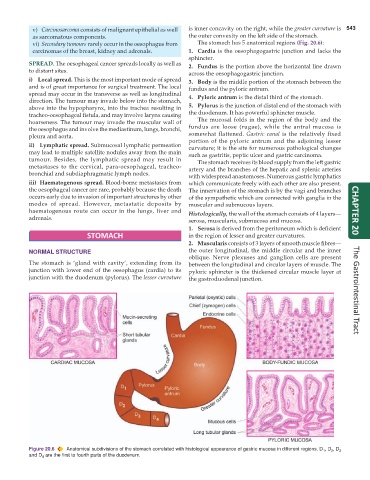
            vi) Secondary tumours rarely occur in the oesophagus from  The stomach has 5 anatomical regions (Fig. 20.6):
            carcinomas of the breast, kidney and adrenals.     1. Cardia is the oesophagogastric junction and lacks the
                                                               sphincter.
           SPREAD. The oesophageal cancer spreads locally as well as  2. Fundus is the portion above the horizontal line drawn
           to distant sites.                                   across the oesophagogastric junction.
           i) Local spread. This is the most important mode of spread  3. Body is the middle portion of the stomach between the
           and is of great importance for surgical treatment. The local  fundus and the pyloric antrum.
           spread may occur in the transverse as well as longitudinal  4. Pyloric antrum is the distal third of the stomach.
           direction. The tumour may invade below into the stomach,
           above into the hypopharynx, into the trachea resulting in  5. Pylorus is the junction of distal end of the stomach with
           tracheo-oesophageal fistula, and may involve larynx causing  the duodenum. It has powerful sphincter muscle.
           hoarseness. The tumour may invade the muscular wall of  The mucosal folds in the region of the body and the
           the oesophagus and involve the mediastinum, lungs, bronchi,  fundus are loose (rugae), while the antral mucosa is
           pleura and aorta.                                   somewhat flattened.  Gastric canal is the relatively fixed
                                                               portion of the pyloric antrum and the adjoining lesser
           ii)  Lymphatic spread. Submucosal lymphatic permeation  curvature; it is the site for numerous pathological changes
           may lead to multiple satellite nodules away from the main  such as gastritis, peptic ulcer and gastric carcinoma.
           tumour. Besides, the lymphatic spread may result in    The stomach receives its blood supply from the left gastric
           metastases to the cervical, para-oesophageal, tracheo-  artery and the branches of the hepatic and splenic arteries
           bronchial and subdiaphragmatic lymph nodes.
                                                               with widespread anastomoses. Numerous gastric lymphatics
           iii)  Haematogenous spread. Blood-borne metastases from  which communicate freely with each other are also present.
           the oesophageal cancer are rare, probably because the death  The innervation of the stomach is by the vagi and branches
           occurs early due to invasion of important structures by other  of the sympathetic which are connected with ganglia in the
           modes of spread. However, metastatic deposits by    muscular and submucous layers.
           haematogenous route can occur in the lungs, liver and  Histologically, the wall of the stomach consists of 4 layers—  CHAPTER 20
           adrenals.                                           serosa, muscularis, submucosa and mucosa.
                                                               1. Serosa is derived from the peritoneum which is deficient
                              STOMACH                          in the region of lesser and greater curvatures.
                                                               2. Muscularis consists of 3 layers of smooth muscle fibres—
           NORMAL STRUCTURE                                    the outer longitudinal, the middle circular and the inner
                                                               oblique. Nerve plexuses and ganglion cells are present
           The stomach is ‘gland with cavity’, extending from its  between the longitudinal and circular layers of muscle. The
           junction with lower end of the oesophagus (cardia) to its  pyloric sphincter is the thickened circular muscle layer at
           junction with the duodenum (pylorus). The lesser curvature  the gastroduodenal junction.                   The Gastrointestinal Tract


           Figure 20.6  Anatomical subdivisions of the stomach correlated with histological appearance of gastric mucosa in different regions. D , D , D 3
                                                                                                              2
                                                                                                            1
           and D 4  are the first to fourth parts of the duodenum.

