


Page 564 - Textbook of Pathology, 6th Edition
P. 564
548


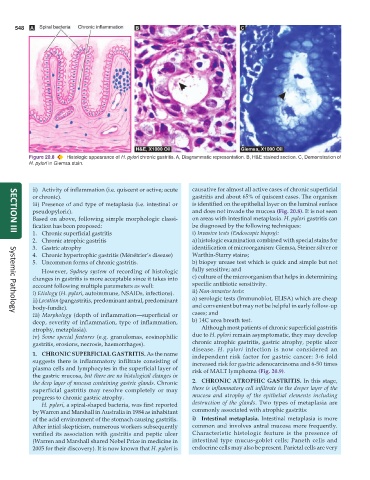
           Figure 20.8  Histologic appearance of H. pylori chronic gastritis. A, Diagrammatic representation. B, H&E stained section. C, Demonstration of
           H. pylori in Giemsa stain.


            ii) Activity of inflammation (i.e. quiscent or active; acute  causative for almost all active cases of chronic superficial
            or chronic).                                         gastritis and about 65% of quiscent cases. The organism
            iii) Presence of and type of metaplasia (i.e. intestinal or  is identified on the epithelial layer on the luminal surface
            pseudopyloric).                                      and does not invade the mucosa (Fig. 20.8). It is not seen
            Based on above, following simple morphologic classi-  on areas with intestinal metaplasia. H. pylori gastritis can
            fication has been proposed:                          be diagnosed by the following techniques:
            1. Chronic superficial gastritis                     i) Invasive tests (Endoscopic biopsy):
     SECTION III
            2. Chronic atrophic gastritis                        a) histologic examination combined with special stains for
            3. Gastric atrophy                                   identification of microorganism: Giemsa, Steiner silver or
            4. Chronic hypertrophic gastritis (Ménétrier’s disease)  Warthin-Starry stains;
            5. Uncommon forms of chronic gastritis.              b) biopsy urease test which is quick and simple but not
               However, Sydney system  of recording of histologic  fully sensitive; and
            changes in gastritis is more acceptable since it takes into  c) culture of the microorganism that helps in determining
            account following multiple parameters as well:       specific antibiotic sensitivity.
            i) Etiology (H. pylori, autoimmune, NSAIDs, infections).  ii) Non-invasive tests:
            ii) Location (pangastritis, predominant antral, predominant  a) serologic tests (Immunoblot, ELISA) which are cheap
            body-fundic).                                        and convenient but may not be helpful in early follow-up
            iii)  Morphology (depth of inflammation—superficial or  cases; and
     Systemic Pathology
            deep, severity of inflammation, type of inflammation,  b) 14C urea breath test.
            atrophy, metaplasia).                                   Although most patients of chronic superficial gastritis
            iv)  Some special features  (e.g. granulomas, eosinophilic  due to H. pylori remain asymptomatic, they may develop
            gastritis, erosions, necrosis, haemorrhages).        chronic atrophic gastritis, gastric atrophy, peptic ulcer
                                                                 disease.  H. pylori infection is now considered an
            1. CHRONIC SUPERFICIAL GASTRITIS. As the name        independent risk factor for gastric cancer: 3-6 fold
            suggests there is inflammatory infiltrate consisting of  increased risk for gastric adenocarcinoma and 6-50 times
            plasma cells and lymphocytes in the superficial layer of  risk of MALT lymphoma (Fig. 20.9).
            the gastric mucosa, but there are no histological changes in
            the deep layer of mucosa containing gastric glands. Chronic  2. CHRONIC ATROPHIC GASTRITIS. In this stage,
            superficial gastritis may resolve completely or may  there is inflammatory cell infiltrate in the deeper layer of the
            progress to chronic gastric atrophy.                 mucosa and atrophy of the epithelial elements including
               H. pylori, a spiral-shaped bacteria, was first reported  destruction of the glands. Two types of metaplasia are
            by Warren and Marshall in Australia in 1984 as inhabitant  commonly associated with atrophic gastritis:
            of the acid environment of the stomach causing gastritis.  i) Intestinal metaplasia. Intestinal metaplasia is more
            After intial skepticism, numerous workers subsequently  common and involves antral mucosa more frequently.
            verified its association with gastritis and peptic ulcer  Characteristic histologic feature is the presence of
            (Warren and Marshall shared Nobel Prize in medicine in  intestinal type mucus-goblet cells; Paneth cells and
            2005 for their discovery). It is now known that H. pylori is  endocrine cells may also be present. Parietal cells are very

