


Page 565 - Textbook of Pathology, 6th Edition
P. 565
muscularis mucosae may extend into the thickened folds.  549
                                                                 Epithelium-lined cysts are commonly seen in the
                                                                 glandular layer. Inflammatory infiltrate is usually mild
                                                                 but lymphoid follicles may be present. The condition is
                                                                 considered significant in view of the risk of developing
                                                                 cancer.
                                                                 5. MISCELLANEOUS FORMS OF CHRONIC GAS-
                                                                 TRITIS. A few other types of gastritis which do not fit
                                                                 into the description of the types of gastritis described
                                                                 above are as under:
                                                                 i) Eosinophilic gastritis. This condition is characterised
                                                                 by diffuse thickening of the pyloric antrum due to oedema
                                                                 and extensive infiltration by eosinophils in all the layers
                                                                 of the wall of antrum. Eosinophilic gastritis probably has
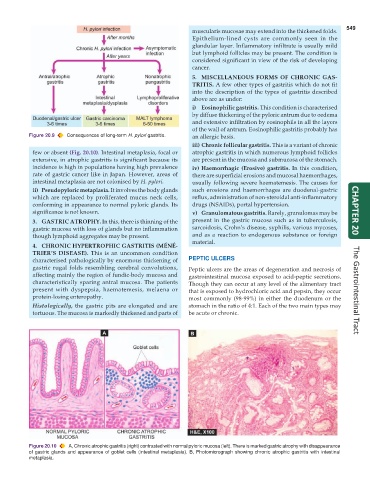
           Figure 20.9  Consequences of long-term H. pylori gastritis.  an allergic basis.
                                                                 iii) Chronic follicular gastritis. This is a variant of chronic
            few or absent (Fig. 20.10). Intestinal metaplasia, focal or  atrophic gastritis in which numerous lymphoid follicles
            extensive, in atrophic gastritis is significant because its  are present in the mucosa and submucosa of the stomach.
            incidence is high in populations having high prevalence  iv) Haemorrhagic (Erosive) gastritis. In this condition,
            rate of gastric cancer like in Japan. However, areas of  there are superficial erosions and mucosal haemorrhages,
            intestinal metaplasia are not colonised by H. pylori.  usually following severe haematemesis. The causes for
            ii) Pseudopyloric metaplasia. It involves the body glands  such erosions and haemorrhages are duodenal-gastric
            which are replaced by proliferated mucus neck cells,  reflux, administration of non-steroidal anti-inflammatory
            conforming in appearance to normal pyloric glands. Its  drugs (NSAIDs), portal hypertension.
            significance is not known.                           v) Granulomatous gastritis. Rarely, granulomas may be  CHAPTER 20
            3. GASTRIC ATROPHY. In this, there is thinning of the  present in the gastric mucosa such as in tuberculosis,
            gastric mucosa with loss of glands but no inflammation  sarcoidosis, Crohn’s disease, syphilis, various mycoses,
            though lymphoid aggregates may be present.           and as a reaction to endogenous substance or foreign
                                                                 material.
            4. CHRONIC HYPERTROPHIC GASTRITIS (MÉNÉ-
            TRIER’S DISEASE). This is an uncommon condition
            characterised pathologically by enormous thickening of  PEPTIC ULCERS
            gastric rugal folds resembling cerebral convolutions,  Peptic ulcers are the areas of degeneration and necrosis of
            affecting mainly the region of fundic-body mucosa and  gastrointestinal mucosa exposed to acid-peptic secretions.
            characteristically sparing antral mucosa. The patients  Though they can occur at any level of the alimentary tract
            present with dyspepsia, haematemesis, melaena or   that is exposed to hydrochloric acid and pepsin, they occur  The Gastrointestinal Tract
            protein-losing enteropathy.                        most commonly (98-99%) in either the duodenum or the
            Histologically, the gastric pits are elongated and are  stomach in the ratio of 4:1. Each of the two main types may
            tortuous. The mucosa is markedly thickened and parts of  be acute or chronic.


           Figure 20.10  A, Chronic atrophic gastritis (right) contrasted with normal pyloric mucosa (left). There is marked gastric atrophy with disappearance
           of gastric glands and appearance of goblet cells (intestinal metaplasia). B, Photomicrograph showing chronic atrophic gastritis with intestinal
           metaplasia.

