


Page 569 - Textbook of Pathology, 6th Edition
P. 569
i) On perforation the contents escape into the lesser sac or  553
                                                               into the peritoneal cavity, causing acute peritonitis.
                                                               ii) Air escapes from the stomach and lies between the liver
                                                               and the diaphragm giving the characteristic radiological
                                                               appearance of air under the diaphragm.
                                                               iii) Subphrenic abscess between the liver and the diaphragm
                                                               may develop due to infection.
                                                               iv) Perforation may extend to involve the adjacent organs e.g.
                                                               the liver and pancreas.
                                                               4. Malignant transformation. The dictum ‘cancers ulcerate
                                                               but ulcers rarely cancerate’ holds true for most peptic ulcers.
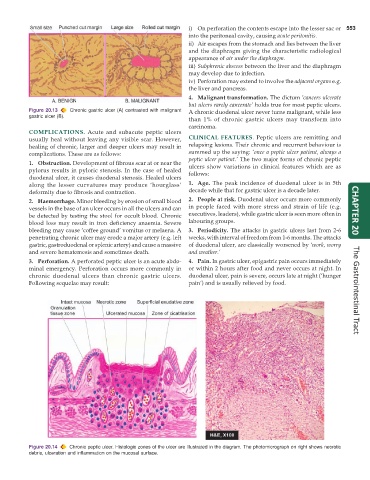
           Figure 20.13  Chronic gastric ulcer (A) contrasted with malignant  A chronic duodenal ulcer never turns malignant, while less
           gastric ulcer (B).
                                                               than 1% of chronic gastric ulcers may transform into
                                                               carcinoma.
           COMPLICATIONS.  Acute and subacute peptic ulcers
           usually heal without leaving any visible scar. However,  CLINICAL FEATURES.  Peptic ulcers are remitting and
           healing of chronic, larger and deeper ulcers may result in  relapsing lesions. Their chronic and recurrent behaviour is
           complications. These are as follows:                summed up the saying: ‘once a peptic ulcer patient, always a
                                                               peptic ulcer patient.’ The two major forms of chronic peptic
           1. Obstruction. Development of fibrous scar at or near the  ulcers show variations in clinical features which are as
           pylorus results in pyloric stenosis. In the case of healed  follows:
           duodenal ulcer, it causes duodenal stenosis. Healed ulcers
           along the lesser curvatures may produce ‘hourglass’  1. Age. The peak incidence of duodenal ulcer is in 5th
           deformity due to fibrosis and contraction.          decade while that for gastric ulcer is a decade later.
           2. Haemorrhage. Minor bleeding by erosion of small blood  2. People at risk. Duodenal ulcer occurs more commonly
           vessels in the base of an ulcer occurs in all the ulcers and can  in people faced with more stress and strain of life (e.g.  CHAPTER 20
           be detected by testing the stool for occult blood. Chronic  executives, leaders), while gastric ulcer is seen more often in
           blood loss may result in iron deficiency anaemia. Severe  labouring groups.
           bleeding may cause ‘coffee ground’ vomitus or melaena. A  3. Periodicity. The attacks in gastric ulcers last from 2-6
           penetrating chronic ulcer may erode a major artery (e.g. left  weeks, with interval of freedom from 1-6 months. The attacks
           gastric, gastroduodenal or splenic artery) and cause a massive  of duodenal ulcer, are classically worsened by ‘work, worry
           and severe hematemesis and sometimes death.         and weather.’
           3. Perforation. A perforated peptic ulcer is an acute abdo-  4. Pain. In gastric ulcer, epigastric pain occurs immediately
           minal emergency. Perforation occurs more commonly in  or within 2 hours after food and never occurs at night. In
           chronic duodenal ulcers than chronic gastric ulcers.  duodenal ulcer, pain is severe, occurs late at night (‘hunger
           Following sequelae may result:                      pain’) and is usually relieved by food.                The Gastrointestinal Tract


           Figure 20.14  Chronic peptic ulcer. Histologic zones of the ulcer are illustrated in the diagram. The photomicrograph on right shows necrotic
           debris, ulceration and inflammation on the mucosal surface.

