


Page 571 - Textbook of Pathology, 6th Edition
P. 571
true phenotypic features of smooth muscle cells, neural cells                                            555
           or Schwann cells. They are uncommon but as compared to
           other sites in the GIT, are most common in the stomach. Their
           behaviour is generally benign but may be recurrent,
           aggressive or even metastasis may occur.

           C. MALIGNANT TUMOURS
           Gastric Carcinoma

           INCIDENCE.  Carcinoma of the stomach comprises more
           than 90% of all gastric malignancies and is the leading cause
           of cancer-related deaths in countries where its incidence is
           high. The highest incidence is between 4th to 6th decades of
           life and is twice more common in men than in women.
           ETIOLOGY.  A number of etiologic factors have been
           implicated in causation of gastric cancer. These are as under:
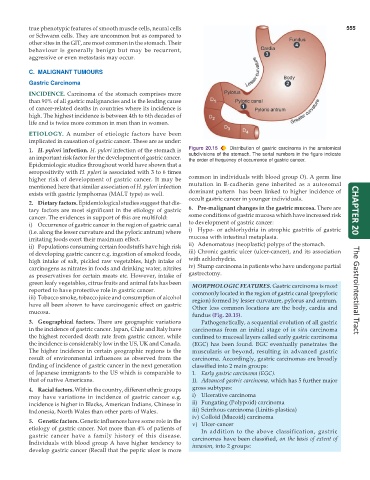
           1. H. pylori infection. H. pylori infection of the stomach is  Figure 20.15  Distribution of gastric carcinoma in the anatomical
           an important risk factor for the development of gastric cancer.  subdivisions of the stomach. The serial numbers in the figure indicate
                                                               the order of frequency of occurrence of gastric cancer.
           Epidemiologic studies throughout world have shown that a
           seropositivity with H. pylori is associated with 3 to 6 times
           higher risk of development of gastric cancer. It may be  common in individuals with blood group O). A germ line
           mentioned here that similar association of H. pylori infection  mutation in E-cadherin gene inherited as a autosomal
           exists with gastric lymphomas (MALT type) as well.  dominant pattern  has been linked to higher incidence of
                                                               occult gastric cancer in younger individuals.
           2. Dietary factors. Epidemiological studies suggest that die-
           tary factors are most significant in the etiology of gastric  6. Pre-malignant changes in the gastric mucosa. There are  CHAPTER 20
           cancer. The evidences in support of this are multifold:  some conditions of gastric mucosa which have increased risk
           i) Occurrence of gastric cancer in the region of gastric canal  to development of gastric cancer:
           (i.e. along the lesser curvature and the pyloric antrum) where  i) Hypo- or achlorhydria in atrophic gastritis of gastric
           irritating foods exert their maximum effect.        mucosa with intestinal metaplasia.
           ii) Populations consuming certain foodstuffs have high risk  ii) Adenomatous (neoplastic) polyps of the stomach.
           of developing gastric cancer e.g. ingestion of smoked foods,  iii) Chronic gastric ulcer (ulcer-cancer), and its association
           high intake of salt, pickled raw vegetables, high intake of  with achlorhydria.
           carcinogens as nitrates in foods and drinking water, nitrites  iv) Stump carcinoma in patients who have undergone partial
           as preservatives for certain meats etc. However, intake of  gastrectomy.
           green leafy vegetables, citrus fruits and animal fats has been  MORPHOLOGIC FEATURES. Gastric carcinoma is most
           reported to have protective role in gastric cancer.   commonly located in the region of gastric canal (prepyloric  The Gastrointestinal Tract
           iii) Tobacco smoke, tobacco juice and consumption of alcohol  region) formed by lesser curvature, pylorus and antrum.
           have all been shown to have carcinogenic effect on gastric  Other less common locations are the body, cardia and
           mucosa.
                                                                 fundus (Fig. 20.15).
           3. Geographical factors. There are geographic variations  Pathogenetically, a sequential evolution of all gastric
           in the incidence of gastric cancer. Japan, Chile and Italy have  carcinomas from an initial stage of  in situ carcinoma
           the highest recorded death rate from gastric cancer, while  confined to mucosal layers called early gastric carcinoma
           the incidence is considerably low in the US, UK and Canada.  (EGC) has been found. EGC eventually penetrates the
           The higher incidence in certain geographic regions is the  muscularis or beyond, resulting in advanced gastric
           result of environmental influences as observed from the  carcinoma. Accordingly, gastric carcinomas are broadly
           finding of incidence of gastric cancer in the next generation  classified into 2 main groups:
           of Japanese immigrants to the US which is comparable to  I. Early gastric carcinoma (EGC).
           that of native Americans.                             II. Advanced gastric carcinoma, which has 5 further major
           4. Racial factors. Within the country, different ethnic groups  gross subtypes:
           may have variations in incidence of gastric cancer e.g.  i) Ulcerative carcinoma
           incidence is higher in Blacks, American Indians, Chinese in  ii) Fungating (Polypoid) carcinoma
           Indonesia, North Wales than other parts of Wales.     iii) Scirrhous carcinoma (Linitis plastica)
                                                                 iv) Colloid (Mucoid) carcinoma
           5. Genetic factors. Genetic influences have some role in the  v) Ulcer-cancer
           etiology of gastric cancer. Not more than 4% of patients of  In addition to the above classification, gastric
           gastric cancer have a family history of this disease.
           Individuals with blood group A have higher tendency to  carcinomas have been classified, on the basis of extent of
                                                                 invasion, into 2 groups:
           develop gastric cancer (Recall that the peptic ulcer is more

