


Page 572 - Textbook of Pathology, 6th Edition
P. 572
556


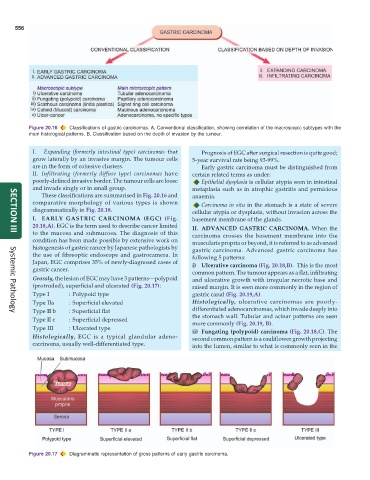
           Figure 20.16  Classifications of gastric carcinomas. A, Conventional classification, showing correlation of the macroscopic subtypes with the
           main histological patterns. B, Classification based on the depth of invasion by the tumour.

            I.  Expanding (formerly intestinal type) carcinomas that  Prognosis of EGC after surgical resection is quite good;
            grow laterally by an invasive margin. The tumour cells  5-year survival rate being 93-99%.
            are in the form of cohesive clusters.                   Early gastric carcinoma must be distinguished from
            II. Infiltrating (formerly diffuse type) carcinomas have  certain related terms as under:
            poorly-defined invasive border. The tumour cells are loose  Epithelial dysplasia is cellular atypia seen in intestinal
            and invade singly or in small group.                 metaplasia such as in atrophic gastritis and pernicious
               These classifications are summarised in Fig. 20.16 and  anaemia.
            comparative morphology of various types is shown        Carcinoma in situ in the stomach is a state of severe
            diagrammatically in Fig. 20.18.                      cellular atypia or dysplasia, without invasion across the
            I. EARLY GASTRIC CARCINOMA (EGC)  (Fig.              basement membrane of the glands.
            20.18,A). EGC is the term used to describe cancer limited  II. ADVANCED GASTRIC CARCINOMA. When the
            to the mucosa and submucosa. The diagnosis of this   carcinoma crosses the basement membrane into the
     SECTION III
            condition has been made possible by extensive work on  muscularis propria or beyond, it is referred to as advanced
            histogenesis of gastric cancer by Japanese pathologists by  gastric carcinoma. Advanced gastric carcinoma has
            the use of fibreoptic endoscope and gastrocamera. In  following 5 patterns:
            Japan, EGC comprises 35% of newly-diagnosed cases of  i) Ulcerative carcinoma (Fig. 20.18,B).  This is the most
            gastric cancer.                                      common pattern. The tumour appears as a flat, infiltrating
            Grossly, the lesion of EGC may have 3 patterns—polypoid  and ulcerative growth with irregular necrotic base and
            (protruded), superficial and ulcerated (Fig. 20.17):  raised margin. It is seen more commonly in the region of
            Type I      : Polypoid type                          gastric canal (Fig. 20.19,A).
            Type IIa    : Superficial elevated                   Histologically, ulcerative carcinomas are poorly-
            Type II b   : Superficial flat                       differentiated adenocarcinomas, which invade deeply into
     Systemic Pathology
            Type II c   : Superficial depressed                  the stomach wall. Tubular and acinar patterns are seen
                                                                 more commonly (Fig. 20.19, B).
            Type III    : Ulcerated type                         ii) Fungating (polypoid) carcinoma (Fig. 20.18,C). The
            Histologically, EGC is a typical glandular adeno-    second common pattern is a cauliflower growth projecting
            carcinoma, usually well-differentiated type.         into the lumen, similar to what is commonly seen in the


           Figure 20.17  Diagrammatic representation of gross patterns of early gastric carcinoma.

