


Page 575 - Textbook of Pathology, 6th Edition
P. 575
559


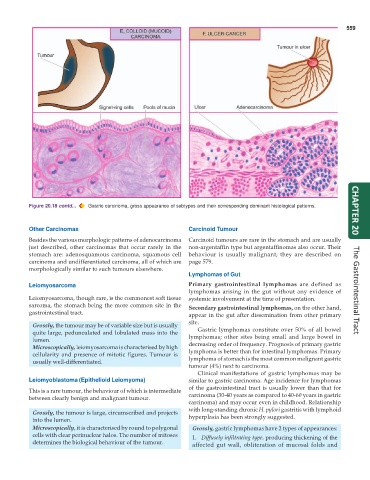
           Figure 20.18 contd...  Gastric carcinoma, gross appearance of subtypes and their corresponding dominant histological patterns.  CHAPTER 20


           Other Carcinomas                                    Carcinoid Tumour
           Besides the various morphologic patterns of adenocarcinoma  Carcinoid tumours are rare in the stomach and are usually
           just described, other carcinomas that occur rarely in the  non-argentaffin type but argentaffinomas also occur. Their
           stomach are: adenosquamous carcinoma, squamous cell  behaviour is usually malignant; they are described on
           carcinoma and undifferentiated carcinoma, all of which are  page 579.
           morphologically similar to such tumours elsewhere.
                                                               Lymphomas of Gut
           Leiomyosarcoma                                      Primary gastrointestinal lymphomas are defined as
                                                               lymphomas arising in the gut without any evidence of   The Gastrointestinal Tract
           Leiomyosarcoma, though rare, is the commonest soft tissue  systemic involvement at the time of presentation.
           sarcoma, the stomach being the more common site in the  Secondary gastrointestinal lymphomas, on the other hand,
           gastrointestinal tract.                             appear in the gut after dissemination from other primary
                                                               site.
            Grossly, the tumour may be of variable size but is usually
            quite large, pedunculated and lobulated mass into the  Gastric lymphomas constitute over 50% of all bowel
            lumen.                                             lymphomas; other sites being small and large bowel in
            Microscopically, leiomyosarcoma is characterised by high  decreasing order of frequency. Prognosis of primary gastric
            cellularity and presence of mitotic figures. Tumour is  lymphoma is better than for intestinal lymphomas. Primary
            usually well-differentiated.                       lymphoma of stomach is the most common malignant gastric
                                                               tumour (4%) next to carcinoma.
                                                                  Clinical manifestations of gastric lymphomas may be
           Leiomyoblastoma (Epithelioid Leiomyoma)             similar to gastric carcinoma. Age incidence for lymphomas
                                                               of the gastrointestinal tract is usually lower than that for
           This is a rare tumour, the behaviour of which is intermediate
           between clearly benign and malignant tumour.        carcinoma (30-40 years as compared to 40-60 years in gastric
                                                               carcinoma) and may occur even in childhood. Relationship
                                                               with long-standing chronic H. pylori gastritis with lymphoid
            Grossly, the tumour is large, circumscribed and projects
            into the lumen.                                    hyperplasia has been strongly suggested.
            Microscopically, it is characterised by round to polygonal  Grossly, gastric lymphomas have 2 types of appearances:
            cells with clear perinuclear halos. The number of mitoses  1. Diffusely infiltrating type, producing thickening of the
            determines the biological behaviour of the tumour.   affected gut wall, obliteration of mucosal folds and

