


Page 576 - Textbook of Pathology, 6th Edition
P. 576
560


     SECTION III


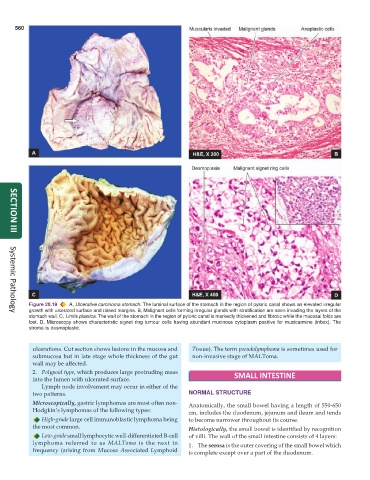
           Figure 20.19  A, Ulcerative carcinoma stomach. The luminal surface of the stomach in the region of pyloric canal shows an elevated irregular
           growth with ulcerated surface and raised margins. B, Malignant cells forming irregular glands with stratification are seen invading the layers of the
     Systemic Pathology
           stomach wall. C, Linitis plastica. The wall of the stomach in the region of pyloric canal is markedly thickened and fibrotic while the mucosal folds are
           lost. D, Microscopy shows characteristic signet ring tumour cells having abundant mucinous cytoplasm positive for mucicarmine (inbox). The
           stroma is desmoplastic.

            ulcerations. Cut section shows lesions in the mucosa and  Tissue). The term pseudolymphoma is sometimes used for
            submucosa but in late stage whole thickness of the gut  non-invasive stage of MALToma.
            wall may be affected.
            2. Polypoid type, which produces large protruding mass
            into the lumen with ulcerated surface.                            SMALL INTESTINE
               Lymph node involvement may occur in either of the
            two patterns.                                      NORMAL STRUCTURE
            Microscopically, gastric lymphomas are most often non-  Anatomically, the small bowel having a length of 550-650
            Hodgkin’s lymphomas of the following types:        cm, includes the duodenum, jejunum and ileum and tends
               High-grade large cell immunoblastic lymphoma being  to become narrower throughout its course.
            the most common.                                   Histologically, the small bowel is identified by recognition
               Low-grade small lymphocytic well-differentiated B-cell  of villi. The wall of the small intestine consists of 4 layers:
            lymphoma referred to as  MALToma is the next in    1. The serosa is the outer covering of the small bowel which
            frequency (arising from Mucosa Associated  Lymphoid  is complete except over a part of the duodenum.

