


Page 578 - Textbook of Pathology, 6th Edition
P. 578
562


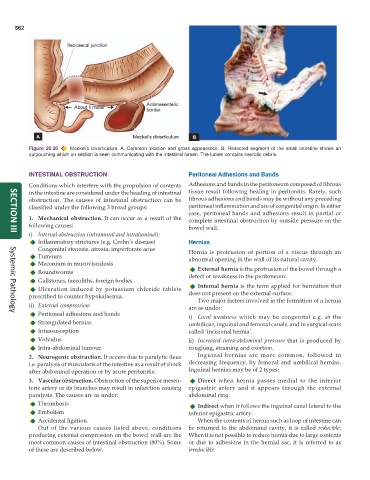
           Figure 20.20  Meckel’s diverticulum. A, Common location and gross appearance. B, Resected segment of the small intestine shows an
           outpouching which on section is seen communicating with the intestinal lumen. The lumen contains necrotic debris.


           INTESTINAL OBSTRUCTION                              Peritoneal Adhesions and Bands

           Conditions which interfere with the propulsion of contents  Adhesions and bands in the peritoneum composed of fibrous
           in the intestine are considered under the heading of intestinal  tissue result following healing in peritonitis. Rarely, such
           obstruction. The causes of intestinal obstruction can be  fibrous adhesions and bands may be without any preceding
           classified under the following 3 broad groups:      peritoneal inflammation and are of congenital origin. In either
                                                               case, peritoneal bands and adhesions result in partial or
           1. Mechanical obstruction. It can occur as a result of the  complete intestinal obstruction by outside pressure on the
           following causes:                                   bowel wall.
           i) Internal obstruction (intramural and intraluminal):
     SECTION III
              Inflammatory strictures (e.g. Crohn’s disease)   Hernias
              Congenital stenosis, atresia, imperforate anus   Hernia is protrusion of portion of a viscus through an
              Tumours                                          abnormal opening in the wall of its natural cavity.
              Meconium in mucoviscidosis
                                                                  External hernia is the protrusion of the bowel through a
              Roundworms                                       defect or weakness in the peritoneum.
              Gallstones, faecoliths, foreign bodies
              Ulceration induced by potassium chloride tablets    Internal hernia is the term applied for herniation that
           prescribed to counter hypokalaemia.                 does not present on the external surface.
                                                                  Two major factors involved in the formation of a hernia
           ii) External compression:                           are as under:
              Peritoneal adhesions and bands                   i) Local weakness which may be congenital e.g. at the
     Systemic Pathology
              Strangulated hernias                             umbilicus, inguinal and femoral canals, and in surgical scars
              Intussusception                                  called ‘incisional hernia’.
              Volvulus                                         ii) Increased intra-abdominal pressure that is produced by
              Intra-abdominal tumour.                          coughing, straining and exertion.
           2. Neurogenic obstruction. It occurs due to paralytic ileus  Inguinal hernias are more common, followed in
           i.e. paralysis of muscularis of the intestine as a result of shock  decreasing frequency, by femoral and umbilical hernias.
           after abdominal operation or by acute peritonitis.  Inguinal hernias may be of 2 types:
           3. Vascular obstruction. Obstruction of the superior mesen-  Direct when hernia passes medial to the inferior
           teric artery or its branches may result in infarction causing  epigastric artery and it appears through the external
           paralysis. The causes are as under:                 abdominal ring.
              Thrombosis                                          Indirect when it follows the inguinal canal lateral to the
              Embolism                                         inferior epigastric artery.
              Accidental ligation.                                When the contents of hernia such as loop of intestine can
              Out of the various causes listed above, conditions  be returned to the abdominal cavity, it is called  reducible.
           producing external compression on the bowel wall are the  When it is not possible to reduce hernia due to large contents
           most common causes of intestinal obstruction (80%). Some  or due to adhesions in the hernial sac, it is referred to as
           of these are described below.                       irreducible.

