


Page 579 - Textbook of Pathology, 6th Edition
P. 579
as ischaemic bowel disease. In either case, the cause of  563
                                                               ischaemia is compromised mesenteric circulation, while
                                                               ischaemic effect is less likely to occur in the stomach,
                                                               duodenum and rectum due to abundant collateral blood
                                                               supply.
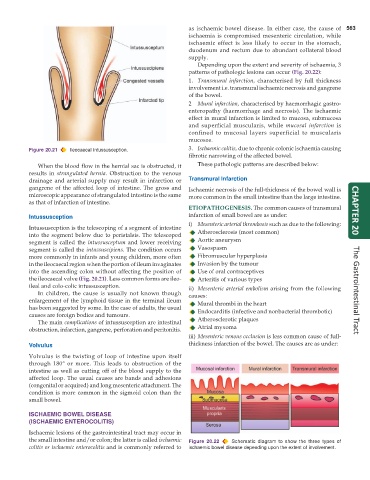
                                                                  Depending upon the extent and severity of ischaemia, 3
                                                               patterns of pathologic lesions can occur (Fig. 20.22):
                                                               1. Transmural infarction, characterised by full thickness
                                                               involvement i.e. transmural ischaemic necrosis and gangrene
                                                               of the bowel.
                                                               2  Mural infarction, characterised by haemorrhagic gastro-
                                                               enteropathy (haemorrhage and necrosis). The ischaemic
                                                               effect in mural infarction is limited to mucosa, submucosa
                                                               and superficial muscularis, while  mucosal infarction is
                                                               confined to mucosal layers superficial to muscularis
                                                               mucosae.
           Figure 20.21  Ileocaecal intussusception.           3. Ischaemic colitis, due to chronic colonic ischaemia causing
                                                               fibrotic narrowing of the affected bowel.

              When the blood flow in the hernial sac is obstructed, it  These pathologic patterns are described below:
           results in  strangulated hernia. Obstruction to the venous
           drainage and arterial supply may result in infarction or  Transmural Infarction
           gangrene of the affected loop of intestine. The gross and  Ischaemic necrosis of the full-thickness of the bowel wall is
           microscopic appearance of strangulated intestine is the same  more common in the small intestine than the large intestine.
           as that of infarction of intestine.
                                                               ETIOPATHOGENESIS. The common causes of transmural      CHAPTER 20
           Intussusception                                     infarction of small bowel are as under:
                                                               i) Mesenteric arterial thrombosis such as due to the following:
           Intussusception is the telescoping of a segment of intestine
           into the segment below due to peristalsis. The telescoped  Atherosclerosis (most common)
           segment is called the intussusceptum and lower receiving  Aortic aneurysm
           segment is called the intussuscipiens. The condition occurs  Vasospasm
           more commonly in infants and young children, more often  Fibromuscular hyperplasia
           in the ileocaecal region when the portion of ileum invaginates  Invasion by the tumour
           into the ascending colon without affecting the position of  Use of oral contraceptives
           the ileocaecal valve (Fig. 20.21). Less common forms are ileo-  Arteritis of various types
           ileal and colo-colic intussusception.               ii) Mesenteric arterial embolism arising from the following
              In children, the cause is usually not known though  causes:                                             The Gastrointestinal Tract
           enlargement of the lymphoid tissue in the terminal ileum  Mural thrombi in the heart
           has been suggested by some. In the case of adults, the usual  Endocarditis (infective and nonbacterial thrombotic)
           causes are foreign bodies and tumours.
              The main complications of intussusception are intestinal  Atherosclerotic plaques
           obstruction, infarction, gangrene, perforation and peritonitis.  Atrial myxoma
                                                               iii) Mesenteric venous occlusion is less common cause of full-
           Volvulus                                            thickness infarction of the bowel. The causes are as under:

           Volvulus is the twisting of loop of intestine upon itself
           through 180° or more. This leads to obstruction of the
           intestine as well as cutting off of the blood supply to the
           affected loop. The usual causes are bands and adhesions
           (congenital or acquired) and long mesenteric attachment. The
           condition is more common in the sigmoid colon than the
           small bowel.

           ISCHAEMIC BOWEL DISEASE
           (ISCHAEMIC ENTEROCOLITIS)
           Ischaemic lesions of the gastrointestinal tract may occur in
           the small intestine and/or colon; the latter is called ischaemic  Figure 20.22  Schematic diagram to show the three types of
           colitis or ischaemic enterocolitis and is commonly referred to  ischaemic bowel disease depending upon the extent of involvement.

