


Page 580 - Textbook of Pathology, 6th Edition
P. 580
564


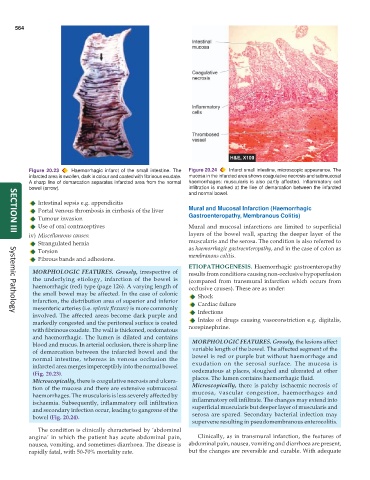
           Figure 20.23  Haemorrhagic infarct of the small intestine. The  Figure 20.24  Infarct small intestine, microscopic appearance. The
           infarcted area is swollen, dark in colour and coated with fibrinous exudate.  mucosa in the infarcted area shows coagulative necrosis and submucosal
           A sharp line of demarcation separates infarcted area from the normal  haemorrhages: muscularis is also partly affected. Inflammatory cell
           bowel (arrow).                                      infiltration is marked at the line of demarcation between the infarcted
                                                               and normal bowel.
              Intestinal sepsis e.g. appendicitis
              Portal venous thrombosis in cirrhosis of the liver  Mural and Mucosal Infarction (Haemorrhagic
              Tumour invasion                                  Gastroenteropathy, Membranous Colitis)
              Use of oral contraceptives                       Mural and mucosal infarctions are limited to superficial
           iv) Miscellaneous causes:                           layers of the bowel wall, sparing the deeper layer of the
     SECTION III
              Strangulated hernia                              muscularis and the serosa. The condition is also referred to
              Torsion                                          as haemorrhagic gastroenteropathy, and in the case of colon as
              Fibrous bands and adhesions.                     membranous colitis.
                                                               ETIOPATHOGENESIS. Haemorrhagic gastroenteropathy
            MORPHOLOGIC FEATURES. Grossly, irrespective of     results from conditions causing non-occlusive hypoperfusion
            the underlying etiology, infarction of the bowel is  (compared from transmural infarction which occurs from
            haemorrhagic (red) type (page 126). A varying length of  occlusive causes). These are as under:
            the small bowel may be affected. In the case of colonic  Shock
            infarction, the distribution area of superior and inferior  Cardiac failure
            mesenteric arteries (i.e. splenic flexure) is more commonly  Infections
            involved. The affected areas become dark purple and
     Systemic Pathology
            markedly congested and the peritoneal surface is coated  Intake of drugs causing vasoconstriction e.g. digitalis,
            with fibrinous exudate. The wall is thickened, oedematous  norepinephrine.
            and haemorrhagic. The lumen is dilated and contains
            blood and mucus. In arterial occlusion, there is sharp line  MORPHOLOGIC FEATURES. Grossly, the lesions affect
            of demarcation between the infarcted bowel and the   variable length of the bowel. The affected segment of the
            normal intestine,  whereas in venous occlusion the   bowel is red or purple but without haemorrhage and
            infarcted area merges imperceptibly into the normal bowel  exudation on the serosal surface. The mucosa is
            (Fig. 20.23).                                        oedematous at places, sloughed and ulcerated at other
            Microscopically, there is coagulative necrosis and ulcera-  places. The lumen contains haemorrhagic fluid.
            tion of the mucosa and there are extensive submucosal  Microscopically, there is patchy ischaemic necrosis of
            haemorrhages. The muscularis is less severely affected by  mucosa, vascular congestion, haemorrhages and
            ischaemia. Subsequently, inflammatory cell infiltration  inflammatory cell infiltrate. The changes may extend into
            and secondary infection occur, leading to gangrene of the  superficial muscularis but deeper layer of muscularis and
            bowel (Fig. 20.24).                                  serosa are spared. Secondary bacterial infection may
                                                                 supervene resulting in pseudomembranous enterocolitis.
              The condition is clinically characterised by ‘abdominal
           angina’ in which the patient has acute abdominal pain,  Clinically, as in transmural infarction, the features of
           nausea, vomiting, and sometimes diarrhoea. The disease is  abdominal pain, nausea, vomiting and diarrhoea are present,
           rapidly fatal, with 50-70% mortality rate.          but the changes are reversible and curable. With adequate

